
Category: Educational contents

  • 2026 is the Year of Onchain Infrastructure.

    2026 is the Year of Onchain Infrastructure.

    onchain infrastructure projects could have a big year in 2026

    Probably not a popular article to come across in Web3 these days. The focus has shifted to memecoins and flipping coins for ‘quick bucks’. But if the memecoin hysteria ever subsides and retail pays attention to utility projects, 2026 could be a positive year for projects that offer facilities (Onchain infrastructure) for building businesses on the blockchain. 

    2026 could be the year of onchain infrastructure…optimistically.

    Two onchain infrastructure narratives appeal most to me: Internet Capital Markets and the X402 payment protocol. 

    No pandering, I’ll simply get to it, and in a conversational tone. 

    Internet Capital Market: Onchain Infrastructure democratizing seed investments for retail

    Let me put it this way, crypto is moving away from the usual “bring money, take coin” kind of fundraisers. That, in the past, has mainly benefited Venture capitalists who get in very early and project teams who raise at unreasonable valuations. We’ve seen projects raise hundreds of millions without even building any tangible products.

    So retail investors and VCs with lower reach are increasingly pivoting to fair launches through Internet Capital Markets (ICM).

    The idea of internet capital markets is to enable anyone to build real value on the internet through fair and transparent funding mechanisms. Internet Capital Markets are built on the nuances of decentralization; bridging everything from fundraisers to platform launches and protocol interactions. 

    This is relevant to investors because it lowers barriers to participation and increases transparency. ICM projects already have a cumulative valuation of over $380 million, and are projected to grow to hundreds of billions of dollars. A strong candidate for the most influential narrative next year. 

    Why Internet Capital Markets?

    Regular Launchpads serve two purposes: handle user verifications and transfer purchased assets. You’d expect a plain output, but these platforms have a UX issue, thanks to regulatory and accessibility challenges. 

    In terms of regulation, regular launchpads have little to no influence on how founders set valuations. As a result, founders can raise at an insanely high valuation before even delivering any working prototype. The most telling effect is poor performance after launch and losses for the investor. This was the case with the  2017 ICO boom and many other ICOs, IDOs, and IEOs that followed it.

    In addition, regional restrictions and high investment minimums limit retail participation in fundraisers. 

    Internet capital markets attempt to resolve the limitations of seed investing by reducing known overheads: accessibility and regulation.

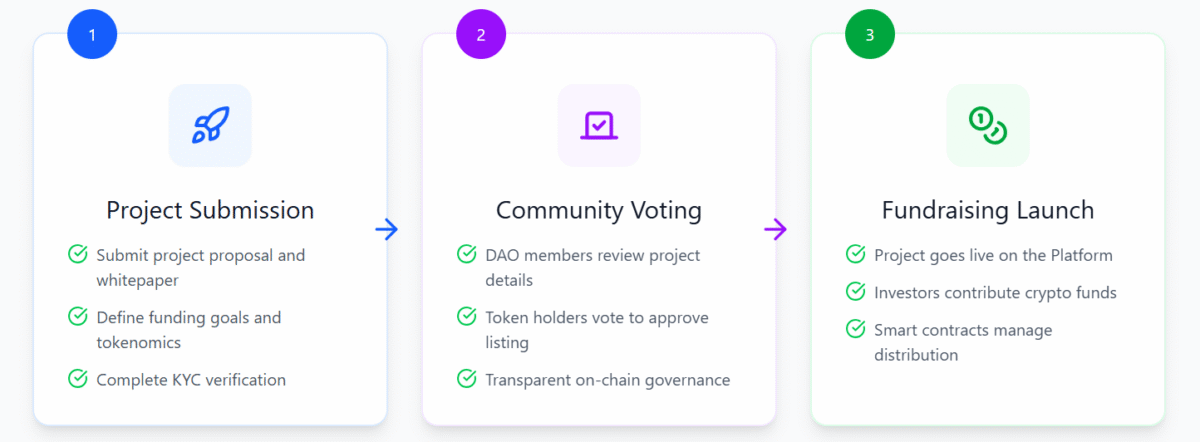
    For a better understanding of the Internet Capital Market, imagine Nasdaq and Y-Combinator, but then fully permissionless. Activities like project listings, funding contributions, and management of funds generated through fundraisers are handled on-chain.

    Internet Capital Markets leverage funding models that decide if a project’s fundamentals are even reasonable enough to be funded. This way, it creates responsible founders. Founders that raise via ICMs can only access the money they got from fundraisers in phases; each phase is defined by specific deliverables that the team must satisfy.

    The model is synergized with smart contracts that handle tokenization, custody of funds, and a data management and verification layer for record-keeping, ensuring that every process runs smoothly.

    If Internet Capital Markets work as expected, a functional ICM platform allows anyone to own a share of new high-potential projects with very low capital and significantly regulates the fundraising structure for intended launches.

    By lowering the barrier to asset issuance and ownership, Internet capital markets open a trove of liquidity and innovation. And this is particularly important for the next stage of crypto and blockchain adoption.

    So why is this even a big deal when it’s just another set of launchpads with more ‘gimmicks’?

    Understanding the Internet Capital Market Meta
    Coinbase acquired Echo from Cobie (Jordan Fish) for  $375 million. Echo is a capital market for new launches. Solana’s marketing team is also putting up campaigns for Internet Capital Markets on Wall Street. Pump.fun, launched Spotlight, an ICM protocol, and published a thesis for Internet Capital Markets. 

    All these are positive for ICM as a crypto narrative. But why the rave? 

    Well, I wouldn’t be surprised if Internet Capital Market turns out to be another buzzword used to milk retail investors. But from a fair standpoint, it is a brilliant idea. 

    Imagine being able to bring anything onchain, from ideas to existing companies. Internet Capital Market implies that the internet is capable of creating dynamism between capital and the market.

    That is, you can raise capital and run a thriving business whose complete operations are online, instead of just using the internet as a front for a business that is completed offline.

    ICMs are important, not only because they will pilot an insane flow of capital, but because they will pioneer an era where everything is moving on-chain through a regulated but permissionless channel.

    Projects in this category will provide handy infrastructures for establishing ideas and businesses on-chain. From advanced launchpads and easy tokenization facilities to project advisory.

    The idea is this: “We will give you a platform to issue your tokens, raise funds through token sales, and launch your projects successfully. But your capital will be locked and can only be released as you make tangible progress”.

    In this last quarter of 2025, we’ve seen a new style of launches.  Projects that launch via ICMs now raise at reasonable valuations to give room for growth. Because capital markets hold them responsible.

    Apart from crypto natives launching new projects, mainstream institutions that wish to move part or a whole of their business on-chain are definitely going to use ICMs.

    ICMs could return the control of the markets to retail, something that previous ICOs, IDOs, and IEOs have failed to do.

    Positioning for the Internet Capital Market meta

    I followed a few fundraiser events on MetaDAO;

    • Umbra
    • Avici and 
    • Omnipair
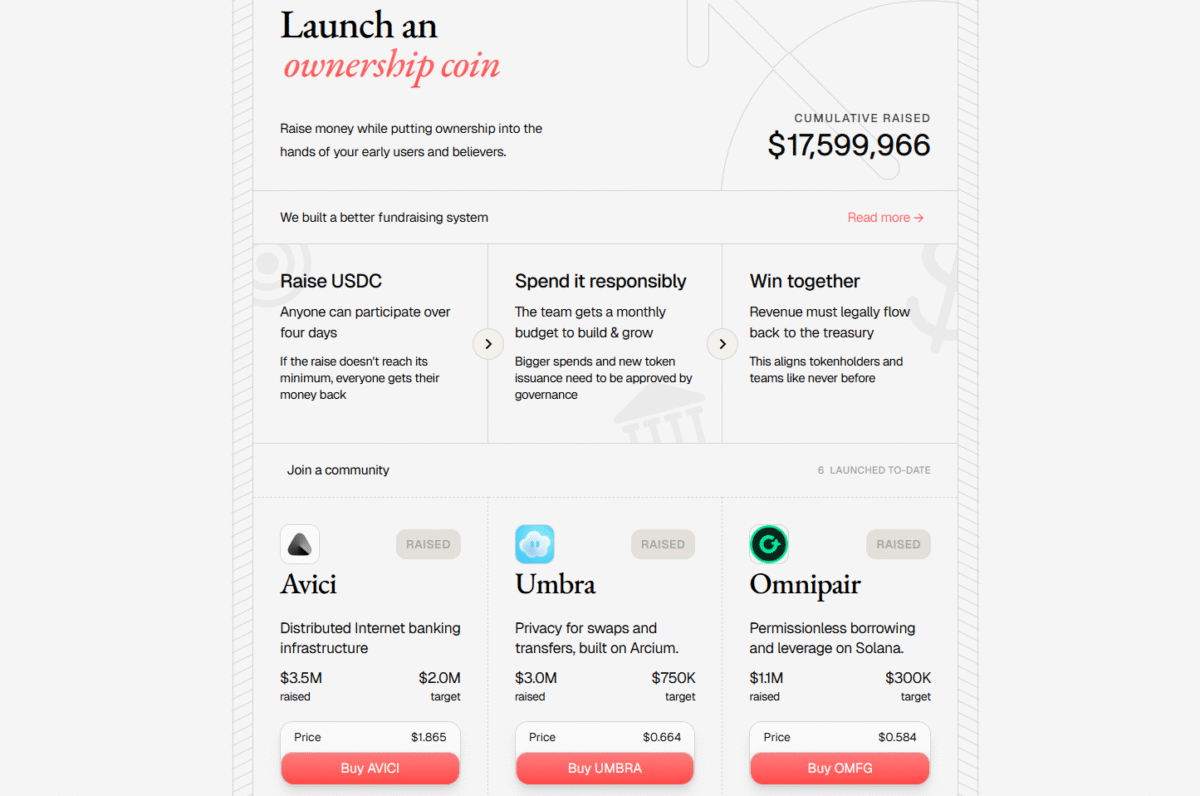
    MetaDAO homepage

    Among these three projects;

    Avici intended to raise $2 million, got $34.2 million in commitments, but only accepted $3.5 million. Umbra, intended to raise $750,000, got $154 million in commitments, but only accepted $3 million.

    To date, 6 projects have raised a total of $17.6 million via MetaDAO. MetaDAO introduced the Futarchy model for deciding projects’ funding proposals. The model uses conditional prediction markets; traders bet $META on “Pass” or “Fail” outcomes of proposals. The proposal passes only if the Pass market price exceeds Fail (via TWAP). 

    A few other ICM platforms exist, but MetaDAO is the most striking yet, in my opinion. DAO Maker, Creator Buddy, and crypto-tradfi tokenization platforms like Backed Finance are other ICM projects you can look up.

    A few things to keep in mind for ICM projects are their existing fundraiser records. For investors just trying to make profits from the narrative, ‘numbers’ are simply what to look at. Founders will launch on ICMs that can drive interest to projects, while investors will use platforms that cater to their financial security. These are the primary metrics for ICMs.

    Another major onchain infrastructure that could shape crypto in 2026 is X402-powered payment for AI agents.

    Agentic payment powered by X402 protocol: infra for AI and AI agents. Driver for Internet Capital Markets
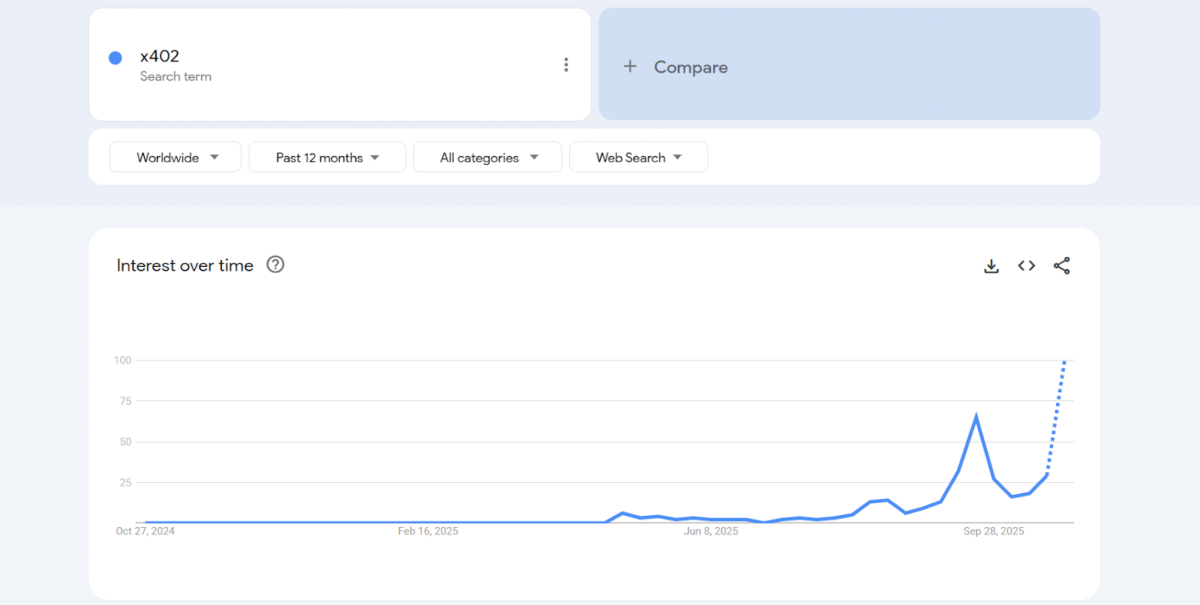
    Google and social media search trends for X402 skyrocketed in late October after the Coinbase developer team showcased how they utilize the X402 protocol for its payment MCP (Model Context Protocol).

    X402 is an internet-native payment protocol. With X402, AI agents, decentralized protocols, data layers, and APIs can interact autonomously without external interference. In a nutshell, using X402 payment rails, AI agents can pay for data on a pay-per-use basis without middlemen.

    Am I excited about X402? Yes. It opens up many possibilities for AI, AI Agents, and Crypto as a whole. For developers, X402 payment rail facilitates building onchain.  It offers a seamless payment system for anyone building in AI and DeFi.

    X402 ecosystem has grown rapidly, and the cumulative market cap of X402-enabled projects is now about $11 billion, according to Coingecko. This number could be deceiving anyways. A majority of big projects in the category are existing projects like Chainlink and Enjin.
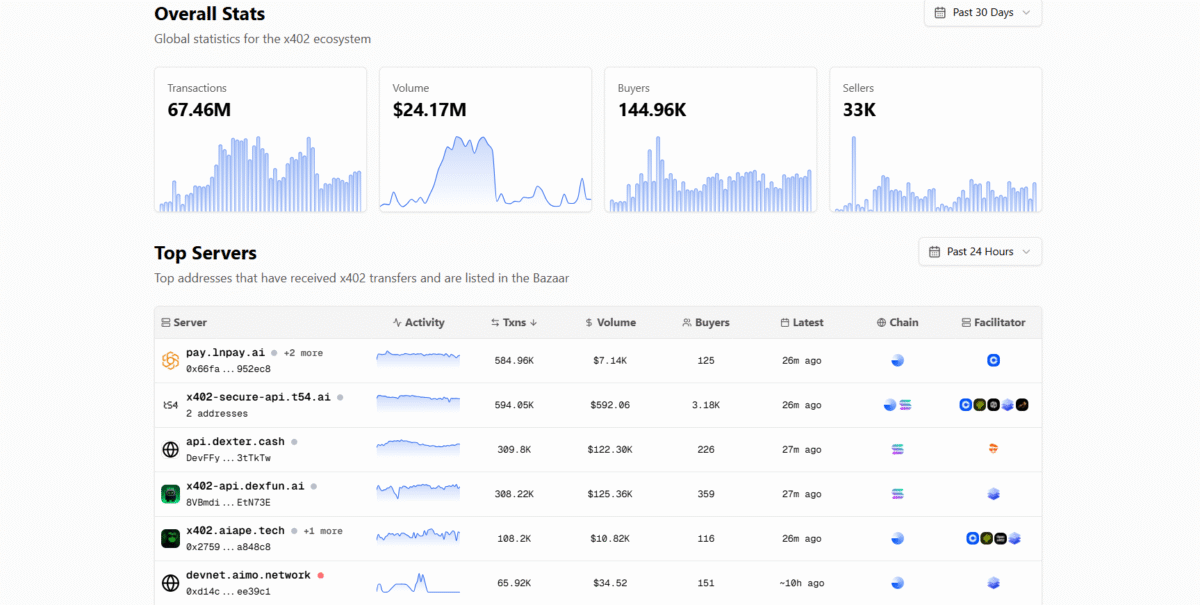
    Overall X402 payment statistics

    X402 transaction data

    According to data from X402 Scan, AI agents have autonomously processed over $24 million via X402 payment rails in the past 30 days, with peaks on November 15 and 18. X402 adoption picked first on Base Network, thanks to Coinbase’s involvement in core development, but the narrative is spreading to other chains, including Solana, Ethereum, and BNB Chain. 

    I admit it, X402 is mostly hype for now. Many projects in the category are only trying to benefit from the narrative and haven’t built anything significant. But there’s a lot to expect in the future, and the X402 boom is bullish for AI and Internet Capital Markets as well, for many reasons.

    First, it is the Internet Capital Market at its best. It enables AI agents to fully run online and onchain without interacting with off-chain resources. Also, it will significantly drive launches as developers build X402 resource systems and projects that utilize the X402 payment rails. Many of these X402 projects will seek funding through ICMs.

    Positioning for an Onchian infra meta driven by ICMs and X402

    Most relevant X402 projects already have a native token. A good way to position for a possible X402-drive rally is investing in these tokens. However, before investing in any of these, consider the project’s relevance to the meta. In the usual crypto culture, many projects will attempt to extract value from retail investors by building a low-end product with an X402 tag. 

    NFA, but some promising projects I’ve come across in the X402 category include Daydreams, Dexter, and Heurist.
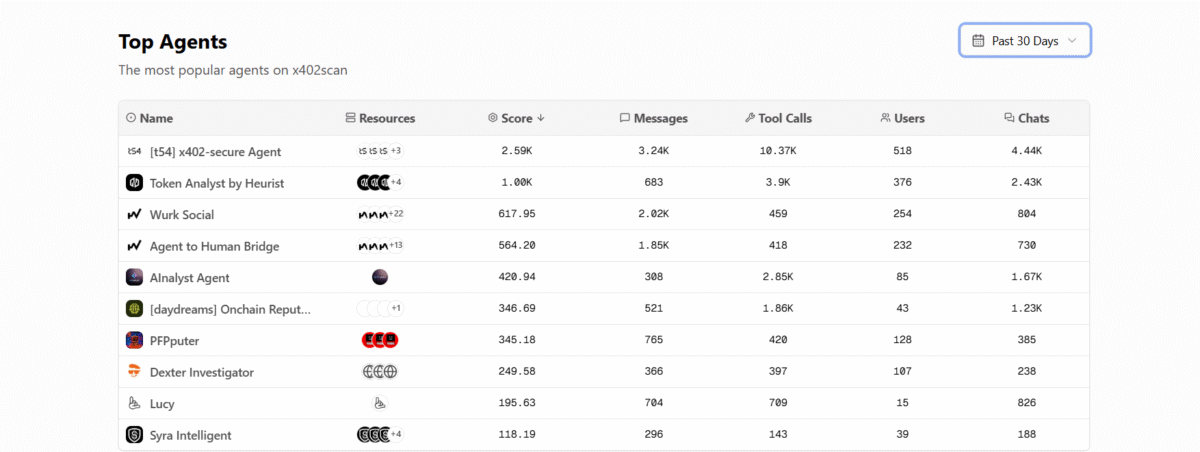
    Top X402 agents according to X402 scan

    Top X402 agents on X402 scan

    While this is not an endorsement or financial advice, Heurist on Base network might be a good one to look at in terms of raw fundamentals. Heurist’s agent has the second-highest number of users and interactions among the top agents in the past four weeks.

    In addition to the agent, Heurist provides key resources and a framework for X402 payment protocols and AI. Part of the revenue generated from X402 transactions is used to buy back HEU tokens, which is also great…the buyback narrative also resonates among retail investors.

    Another promising X402 project you could look at is PayAI. PayAI is an X402 facilitator. It provides tools for autonomous agent interactions.
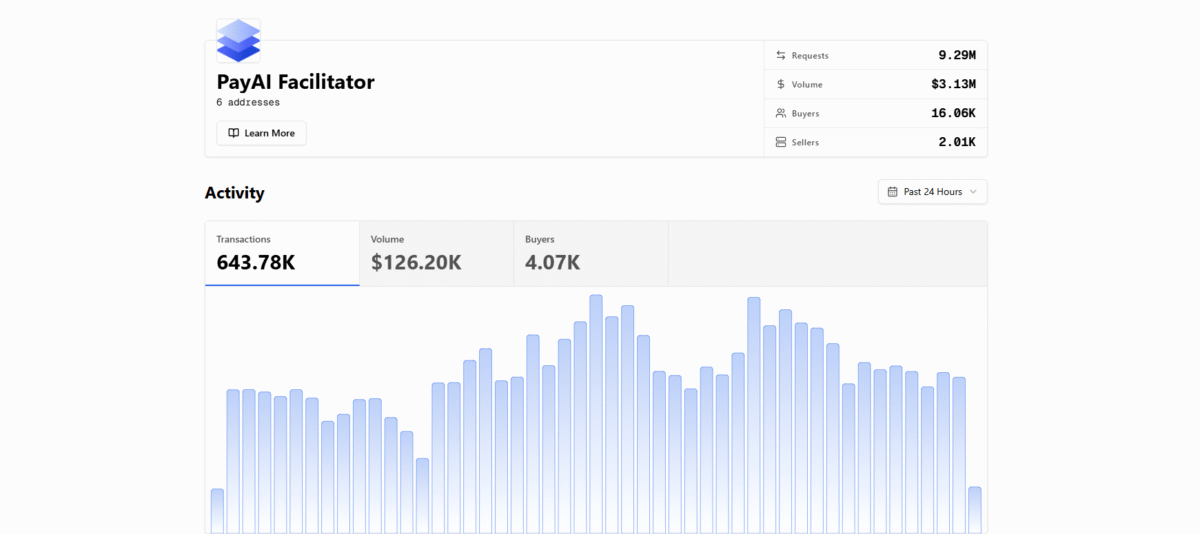
    PayAI X402 payment facilitator

    PayAI data on X402

    In the past 7 days, over 5,000 users have used PayAI to facilitate more than $1.2 million worth of AI agent payments through over 2.14 million transactions.

    At a market cap of $9 million. It still has enough room for growth as X402 gets more popular.

    Rounding Up

    On one side, we have internet capital markets, and on the other side, X402 payments. 

    In commonness, each one attempts to shift from the traditional process and build value on a decentralized internet. ICM for fundraisers and tokenization; X402 for decentralized AI agent payment. 

    We discussed both concepts and how they are poised to make a dent in the crypto market. Having said that, I’d recommend focusing on value, not hype. Several projects will certainly attempt to extract value by adopting any of these narratives. But real builders always come out on top.
  • Top 5 Bitcoin Layer-2 projects in 2024

    Top 5 Bitcoin Layer-2 projects in 2024

    top Bitcoin layer-2 projects

    Bitcoin Layer-2 projects are not just an attempt to scale the performance of the Bitcoin blockchain, but also an attempt to scale the utility of the Bitcoin network. Unlike the Ethereum blockchain which runs a programmable layer, the Bitcoin blockchain is stuck in its primary utility as a P2P payment solution. This in addition to its snail-speed efficiency makes it an archaic network. L2 projects are adopting different approaches to salvage the network and put its rigid security and decentralization facility into more use.

    But what are Bitcoin Layer-2 networks?

    What are Bitcoin Layer-2 networks?

    Bitcoin Layer-2 attempts to run an execution environment away from the Bitcoin network while contracting the Bitcoin Network’s consensus for the final computation of the transactions. By running a separate execution environment, Bitcoin layer-2 networks are able to implement diverse technologies to improve performance and overall user experience while allowing the Bitcoin coin and Network to be used in advanced activities like Decentralized Finance (DeFi).

    An overview of how Bitcoin Layer-2 projects work

    The blockchain is a rigid system. Even new-generation blockchains inherit this rigidity. This means that making significant changes to a blockchain network involves rigorous work-throughs. Direct and simple modifications are hardly possible. Bitcoin in its normal state cannot be easily modified to add a programmable layer or improve its speed. To this effect, Bitcoin Layer-2 projects are approaching the network’s scalability in different ways.

    However, the basic approach is the creation of a stable connection with the Bitcoin network. A connection that at least, allows assets to be moved between the networks. Other Layer-2 networks attempt to achieve even more extensive connections by adopting the Bitcoin network as a settlement layer for transactions. L2 projects like this run an execution environment only and use the Bitcoin consensus layer to verify these transactions and record them in an immutable network. This way, they enjoy security and decentralization close the that of the Bitcoin blockchain.

    Bitcoin Layer-2 projects are growing in Headcount. However, a few of them stands out

    Top Bitcoin Layer-2 projects in 2024

    Nervos CKB Blockchain – Secure and Scalable Layer for Bitcoin Blockchain

    Nervos network

    Nervos is building a multi-layer programmable network for the Bitcoin blockchain. Nervos’ Bitcoin Layer-2, namely Common Knowledge Base (CKB) blockchain, hopes to connect the Bitcoin blockchain’s UTXO model with its Cell model to create a stable communication path for both networks and allow copies of transactions on each network to be transferable between them. CKB leverages, RGB++ protocol, an improvement of the RGB protocol focused on solving the bottlenecks of the latter. CKB will create a stable fusion with the Bitcoin network and its network using the Universal Isomeric Binding (UIB) algorithm proposed by Cipher Wang to map the UTXO assets on the Bitcoin blockchain to the Cells in the Nervos Common Knowledge Base (CKB). The Cell is itself an extension of Bitcoin’s UTXO model.

    With its programmable layer, Nervos will create a 2-way peg with the Bitcoin blockchain, allowing efficient communication. On this layer, Nervos Network will build extra layers to allow properties like privacy and scalability, all these without contacting the Bitcoin blockchain in every instance. This allows it to achieve higher efficiency by eliminating hindrances from the consensus layer of the Bitcoin blockchain. CKB is built to advance every progress made in scaling the Bitcoin blockchain to date. It is dubbed Web5 as it creates a synergy between Web3 and Web2.

    Stacks Network – Bitcoin sidechain powered by Proof of Transfer algorithm

    Stacks Network is a Side chain for the Bitcoin Blockchain capable of running smart contract applications. It runs the Proof of Transfer (POX) consensus algorithm that enables it to lobby miners on the Bitcoin Blockchain to validate transactions performed on its network. This way, Stacks network taps from Bitcoin’s sufficient pool of miners and strengthens its network. Stacks also runs a peg-in and Peg-out protocol that enable Bitcoin holders to port their Bitcoin to the Stacks network. On Stacks network, holders are able to use their Bitcoin on decentralized applications. The Peg-in and Peg-out protocol uses smart contracts deployed on both networks to handle the lock and release on Bitcoin on the Bitcoin network and minting and burning of the Bitcoin token on the Stacks network.

    Bitcoin Lightning network – State channel for enhanced P2P Bitcoin transactions

    The Lightning Network is a state channel for the Bitcoin Network. It creates an offline portal for two parties to transact using Bitcoin. For every set of users using the Lightning network, a separate portal is created. Each party can deposit Bitcoin to this channel and run simultaneous transactions using the deposited Bitcoin. For each new transaction performed on the channel, a new state is created, overriding the previous state. At the end of the transaction, this channel is closed and the final state is sent to the Bitcoin blockchain for final validation.

    By operating away from the Bitcoin blockchain, the Lightning network is able to achieve tremendous speed. The final state is sent to the Bitcoin Network as a single transaction; therefore, the users only pay a single transaction cost, regardless of how many transactions they performed in a single state channel.

    Liquid Network – Bitcoin Sidechain powered the Liquid Federation

    Liquid network claims to offer a faster layer for transacting with Bitcoin. Final settlement time on the network is only 2 minutes. This is significant improvement from Bitcoin network’s settlement time. Liquid network runs a 2-way peg facility that allows Bitcoin holders to bridge their bitcoin to the network. Bitcoin on the Liquid network is represented as L-BTC (Liquid BTC). Liquid Network doesn’t operate via a consensus system, rather, a constituted committee handles the approval of transactions on the network.

    RGB – One-time Bitcoin contracts for lightning network

    RGB is an acronym for ‘Really Good Bitcoin’. It is layer-3 protocol for the Bitcoin Network. RGB allows Bitcoin lightning network users to run programmable operations. In short, it is a programmable layer for the Bitcoin lightning network. Using RGB, users can write smart contracts to handle automated payments and other activities. The RGB protocol can operate without a token, however, it can be used for tokenization projects. RGB’s operations are off the Bitcoin network, just like the lightning network, it allows users to transact with improved speed and pay little or no fees for their transactions.

    A few bottlenecks of RGB include, complicated transaction sequence and the need to memorize seed phrases and transaction history to successfully store RGB assets. RGB++, an improvement of the RGB protocol will eliminate the client side verification process and uses the Nervos CKB blockchain to  run 2-way validation and enable users to transact between Bitcoin and the Nervos CKB blockchain without using bridges. 

    Closing Thoughts

    Bitcoin and the Bitcoin Blockchain are both used. A cryptocurrency, Bitcoin, in its pure form, is limited to two-way transactions between users on the network. As the most secure and decentralized blockchain network, Bitcoin’s consensus system is relegated to validating these P2P transactions. Bitcoin Layer-2 projects are changing this. Thanks to Bitcoin Layer-2 to projects like Nervos and Stacks, Bitcoin can be used in more sectors while projects like Lightning network enable users to transact faster with Bitcoin. Even more exciting is the Nervos network’s approach to scaling the Bitcoin network. A programmable layer and a united transaction model could just be the ingredients the Bitcoin blockchain needs for its next evolution. As these projects evolve, we could see even more efficient ways to scale the Bitcoin blockchain

  • What is pump and dump in crypto and how does it work?

    What is pump and dump in crypto and how does it work?

    pump and dumps

    Pump and dumps are coordinated manipulation of the value of a commodity for a quick rise followed by a sharp drop in the asset’s value. As the name implies, the ‘Pump’ describes a sharp price growth, while the ‘dump’ describes the following sharp drop.
    Pump and Dump is a generic term, with its application cutting across every investment space. However, it has seen more relevance in digital investment spaces. Such practices are easier to effect in environments like these. Such assets include stocks and shares, precious metals, and digital currencies like Bitcoin. This article focuses on Pump and Dumps in the crypto space and how this applies to the everyday trader. First, what is pump and Dump in crypto?

    What is Pump and Dump in Crypto?

    Cryptocurrencies are known for their volatility. But sometimes, this volatility is influenced by artificial causes and could be followed by a sharp drop. The basic concept is sustained, but cryptocurrencies are involved this time. Pump and Dump in crypto is a common concept, for assets with low liquidity, this is even more common. Crypto pumps and dumps are coordinated and targeted towards a pre-selected crypto asset. The common goal here is a quick profit for the perpetrators. Here’s how it works
    How crypto pump and dumps work

    The execution of a pump and dump is straightforward,
    First, a congregation of traders is built using available social media platforms, then the pump and dump selects a crypto asset and crypto exchangeto be used and communicates the schedule for the event and target price.

    During the agreed time, the traders in the community proceed to make quick purchases of the selected asset, this leads to a sharp rise in the value of the asset. The rise attracts other traders to buy into the asset, which further grows the price, when the target price is reached, the traders proceed to sell the purchased asset, making profits and leaving other buyers in losses. The success of the pump and dump depends on how well the community adheres to the plan.

    Another step in a pump and dump is the shilling of the asset. This usually starts after the community members have made their purchase. A coordinated dissemination of information about the asset follows. This attracts other traders to take a look at the asset which is already growing in price. This is also known as a pump signal, but it is not limited to this explanation.

    What is a pump signal?

    For the pump and dump community, a pump signal is a notice of the details of the pump and dump. It is an invitation to purchase the asset before the external pump signal commences. For the non-members of the community, the Pump signal is usually a shill by contracted influencers or community members. This is done by a coordinated positive evaluation of the asset, including the sudden price growth. This attracts more people to buy and grows the price further.

    What are Pump and Dump groups?

    Most crypto pump and dump groups use Telegram, another known social media platform used by crypto Pump and Dump groups is Discord. Depending on the popularity of the pump and dump group, each community could consist of a few hundred to thousands of traders.

    The pump and dump groups consist of different tiers of members. The Admins control activities in the group, including the dissemination of information about the intended activity. The community also consists of coaches who are usually tasked with educating new members of the community’s culture. Older members are also tasked with inviting other traders to the group, this is usually rewarded with perks such as a growth in their rank. This might mean access to more information.

    How to detect Pump and Dumps

    Due to the widespread volatility of cryptocurrencies, it is hard to differentiate a pump and dump from a genuine price jerk. However, there are a few things to look out for

    Liquidity and popularity of asset

    If a relatively obscure crypto asset with low liquidity suddenly starts going up massively in price. It is advised to do proper research before buying into the pump. Low liquidity and less popular assets are easy targets for pump-and-dump groups. This is because their price moves up easily.

    Sudden hype

    One of the ways pump and dump groups boost their profits is by shilling the target asset. If an asset suddenly starts being discussed by social media accounts and popular traders, it is also advised to do further research.

    While this doesn’t guarantee it to be a pump and dump, it is one of the common characteristics of known pump and dump cases.

    What are pump bots and how can they help you make profits?

    The hack in pump and dump is Speed. Your ability to detect the pump, and make quick buys and quick sale is paramount to making profits in your trade. A pump bot can help you do each of these faster and with ease.

    Once you obtain information about the assets to be pumped, the pump bot can help you make a quick buy and when you wish to sell, the bot can also help you make a sale. This can be done in a few seconds. Some advanced bots can be automated to make repeated buys and sales according to set algorithms.

    FAQ

    Are Pump and Dumps legal?

    The legal provisions for pump and dumps are not clear, since it is not the same as insider trading. However, from a financial law aspect, they are illegal as artificial manipulation of community prices is illegal.

    How much profit can you make from a pump and dump?

    How much profit you can make from a pump and dump depends on four factors.

    • Your capital
    • Your point of purchase
    • The Success of the pump and dump activity
    • Your point of sale

    You can make a substantial amount if you buy early and sell before the asset starts to dump.

    Is it possible to join a pump and dump group?

    Yes, however, this might depend on the community structure. Some Pump and Dump groups are public while some are strictly based on invitation.

    Conclusion

    Pump and dump is a turbulent way to make profits. while this can be rewarding, it also has its risks. One of the risks is being trapped when the asset dumps. Traders who fail to take profit before the pump even ends could run into losses. Therefore, it is important to do proper research and invest wisely |

  • How crypto fared in 2023

    How crypto fared in 2023

    2023 report.png

    2023 is one of those events you cannot describe with one word. It’s been a hell of a year! If anyone in the government gets to read this; consider extending the holidays. Unfortunately, in the capitalist world we live in, this isn’t even up to the government anymore. One of the year’s biggest events in crypto is Bitcoin’s climb to $44,000 from levels below $17,000. An over %150 rise in a year is a significant one. Ethereum hit $2,300 as well…at least we are leaving this year better than we met it. Yes ‘WE’.

    Well, while you decipher that, here are some of the notable events of the year;

    Rug Pull, court, jail

    caroline coutroom painting.jpg

    Forbes’ ’30 Under 30’ is the new prerequisite for jail time, at least that’s the new conspiracy theory. It’s not really a ‘theory’ when we’ve seen it play out quite a couple of times this year and even the years before. In the crypto space, there’s been lots of court time and jail time. Luna guys, FTX guys, and maybe Binance too. Different levels of Rug pull. We will keep calling out the memecoin rugpulls, but the CEX rugpulls are a thing. The space needs regulation, no doubt, even though the regulators aren’t the best kind of people. Several interventions have seen notable figures in the space go through court sessions and potentially, jail time. Financial crimes aren’t a joke, but we can’t keep ourselves from finding something funny out of any situation…like the courtroom painting of Mrs. Caroline.

    Institutional insurgence on crypto

    bitcoin EFT.jpg

    Multi-billion dollar mainstream financial institutions are steering into the crypto space in many ways. The mainstream VC invasion has been a thing for a while, but some big money institutions are launching spot ETFs for cryptocurrencies. Bitcoin, Ethereum, Bitcoin Cash, and LiteCoin. According to rumors, there is one for XRP…and PEPE. Not sure about these two but if the rumors are true, then the theory about mainstream institutions “coming for your Bitcoins” might be true as well. The BlackRock spot ETF for Bitcoin is yet to launch, but ‘rumors’ have it that we are close. Didn’t happen this year, maybe next year. Regardless, of the intent, we are seeing an increased mainstream exposure. This could be good for the price, we are not sure what it means for ‘Satoshi’s Vision”, but the random altcoin trader will take a solid 10X over that.

    L2, Meme, Cashout, repeat

    crypto pepe.jpg

    Over 11,000 cryptocurrencies are listed on asset-tracking platforms. Untracked assets are at least twice this figure, mostly memecoins. ‘Blue chip memecoins’, RugPull memecoins, and proper memecoins that accept their fate as being reliant on pumpamentals…and luck. But if you made that quick 10X on assets like this, then you can proudly enjoy your win. Like the past two years, 2023 witnessed a flood of memecoins, just like the tons of Layer-2 scaling solutions that launched this year. For each new L2, there are at least 50 memecoins, we’ve lost count of the memecoins on Ethereum and other L1s. Many L2’s usage statistics ride on the back of memecoins, and this is fine. We just want you to know that Memecoins didn’t die in 2023, we’ll check again in 2024.

    Bitcoin – The new ‘Ethereum Killer’

    Blog_Post_BRC-20.png

    BRC-20, BitVM…the Bitcoin blockchain now runs its own kind of smart contract. On the bright side, you can inscribe data on the Bitcoin network, on the other side, the Bitcoin blockchain was developed for the sole purpose of P2P transactions. The experiments are cool, but the after-effects are also significant. But this is not the time to say these; this paragraph only serves to inform readers that Bitcoin could be gearing up for a (very) new set of utilities. BRC-20 tokens and NFT-like inscriptions made the wave in the second and third quarters of 2023. The hype has died down since this time. The team behind BitVm is developing a Virtual Machine for the Bitcoin blockchain, these developments could shape 2024.

    The Airdrop hunting continues

    crypto airdrop hunting.jpg

    Every new protocol that launched in 2023 reached the one million user milestone in a very short time. We’d like to attribute this to the quality of these projects. But once we are done with that, we’d also like to talk about an obvious major contributor – Airdrop hunting! Lots of juicy airdrops from 2020-2022 and no one wishes to be left behind in the next multi-thousand dollar earndrop. So, the hunting continues. Good enough, even more projects have conducted such programs this year; Arbitrum, Celestia, PYTH network, no need for a long list. The average airdrop hunter should have something to show for the ‘hustles’ this year!

    Not to jinx it, but 2023 looks like a perfect tone-setter for a massive 2024. The coming year is packed already and this year has done a good job at shining the lights to even better things…hopefully. If we don’t witness another Luna-level collapse, 2024 might just be the year. 2023 was a huge role-player here. The whole space has gone through a huge rebuild and regardless of how it went on individual terms, it is another one for the record books. And if you ever thought memecoins would fade out one day, this year is a good reminder that things like this are part of what makes this space what it is. The lights fade; the show continues in 2024!

    Follow up with CRYPTOCURRENCY SCRIPTS to stay refreshed in the crypto space with comprehensive articles and important tips.

    Hire a freelance writer

  • Exploring DexCheck token ($DCK) Utility

    Exploring DexCheck token ($DCK) Utility

    dexcheck token

    The DexCheck ecosystem is powered by the DexCheck token. DexCheck token currently trades at $0.022 at the time of writing with a total market cap of just $3 million. The DexCheck ecosystem is built to grow mutually with the DexCheck token. The DexCheck token can be traded on decentralized exchanges on Ethereum and Binance Smart Chain (PancakeSwap) and centralized exchanges like Kucoin and MEXC.

    For the over 6,000 investors who currently hold DexCheck tokens in their personal wallets and investors who will be buying this token in the future, there are a number of benefits. These benefits are related to the ecosystem and beyond it.

    We explore some of the use cases of the DexCheck token.

    Platform access and privileges

    Staking the DexCheck token qualifies you for numerous benefits on the platform. One of these benefits is access to special applications according to the tiered provisions. Note that you only need to stake your tokens to qualify for these benefits. Staking at least 20,000 DCK tokens allows you to enjoy pro traders’ features.

    This includes access to applications like InsightGPT and top traders analytics. Staking the DexCheck token also gives you access to the IPSO and allows you to participate in the revenue-sharing program.

    IPSO is DexCheck’s launchpad which is open to stakers only. Stakers are given the opportunity to invest in new projects before they launch. The revenue-sharing program allows stakers to benefit from the platform’s financial success.

    Passive Income Opportunities

    DexCheck offers income opportunities to holders of the DCK token through staking programs and yield-farming opportunities. The on-chain staking program offers APY of up to 35%. APY varies according to the selected lock-up period which could be up to one year.

    DexCheck also partners with centralized exchanges to host staking programs for investors. the recent staking program in partnership with Kucoin offers investors up to 100% APY for staking their tokens on the exchange. Liquidity providers for the DexCheck token trading pairs on decentralized exchanges also earn from the trading fees paid by other traders. The revenue-sharing program is also a good income opportunity presented by DexCheck.

    Governance

    The DCK token also plays a role in the administration of the project, DCK holders, through the DexCheck DAO can vote on proposals concerning the development of the project. Through the DCK token, DexCheck tokenizes the governance of the project, this makes for decentralization at every level. DCK token holders can vote on proposals related to platform upgrades, fee structures, token burns, and other important decisions. Holding the DCK token gives you a say in the project you are invested in.

    Intrinsic value investment

    The value of the DexCheck token fluctuates over time. Investors bet on the possibility of the token’s value appreciating over time according to market conditions and the project’s fundamentals. While market conditions are unpredictable, projects with strong fundamentals are known to grow over time. DexCheck has solid fundamentals the token’s value has been in appreciation for a majority of its existence. In addition to the utilities mentioned above, holding the DexCheck token can also return tangible value to investors. Investors can decide to hold the tokens and trade them in when the value grows or commit them to any of the passive income programs for extra benefits.

    Closing Thoughts

    Click here to see active trading pairs for the DexCheck token. We have discussed a few benefits of holding the DexCheck token. These are accurate at the time of writing. These benefits could improve as the project continues to grow, but it is also important to note the risks of investing in crypto assets. It is recommended that investors do proper research before purchasing any crypto assets. Also, note that this article is not financial advice.

  • DexCheck Pro trader features you are missing out on.

    DexCheck Pro trader features you are missing out on.

    DexCheck is empowering cryptocurrency investors to make informed decisions in their routine investments. By making actionable data available at every trader’s fingertips, DexCheck hopes to improve the recorded success rate for cryptocurrency investments. In a space as volatile and challenging as this one, this is for sure a tasking goal. I have made a number of reviews of the different applications in the DexCheck ecosystem. The telegram bots and the wallet analytics applications are at the top of my list, but there is still a whole lot to discover.

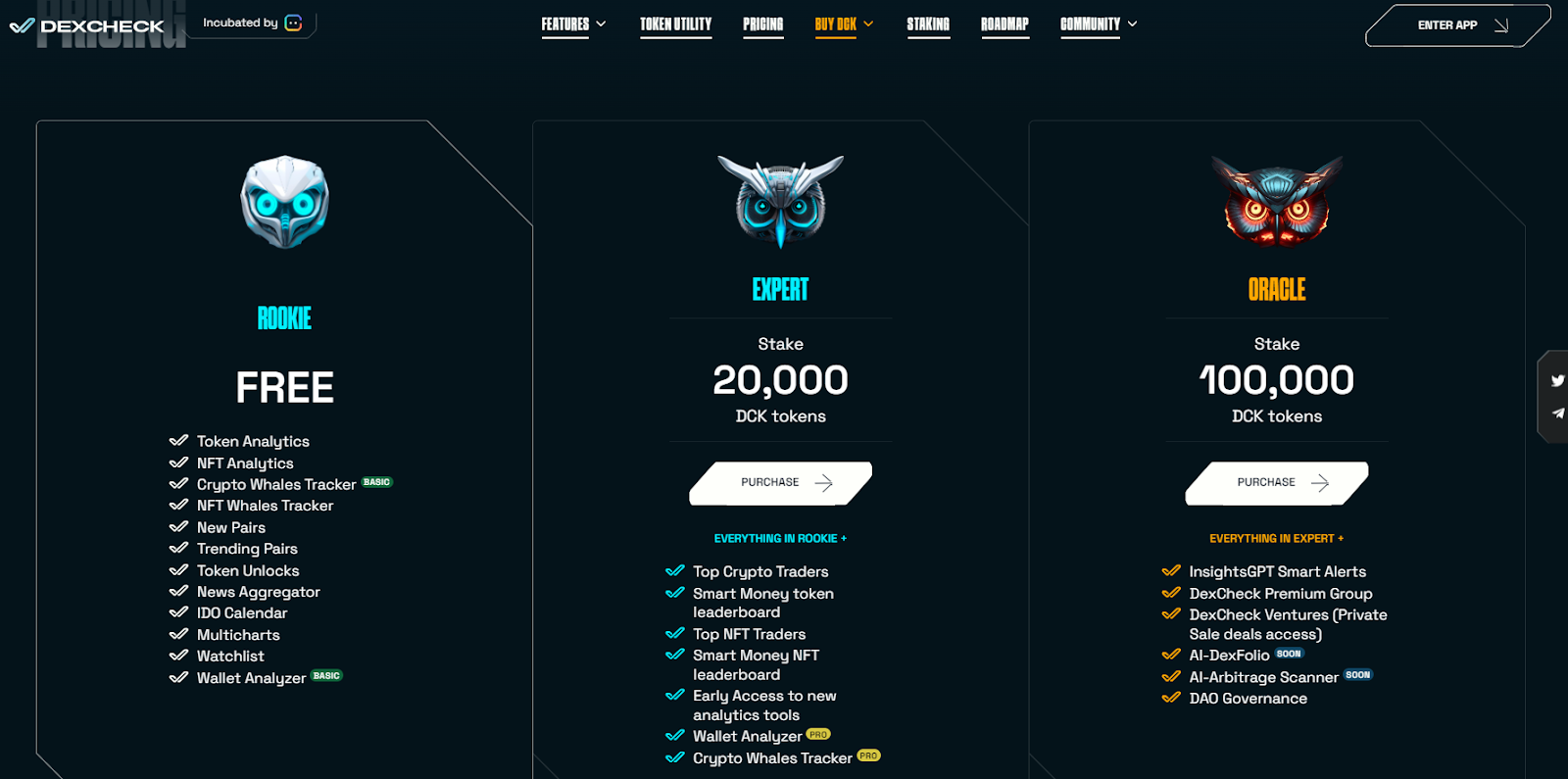
    The Telegram bot and most of the analytics applications are free to use, technically, all applications in the DexCheck ecosystem are free to use. However, the pro features will require you to stake some DexCheck tokens. By staking the DexCheck token, you also get to enjoy tons of staking benefits in addition to gaining access to the Pro features. There are two tiers, expert and Oracle. To enjoy expert features, you will need to stake at least 20,000 $DCk. The Oracle tier is the most advanced tier and gives you access to every feature on the platform. The required stake to enjoy Oracle benefits is 100,000 $DCK. At current DCK token prices, this is about $2000. You can purchase DCK tokens from Kucoin, PancakeSwap, and MEXC exchange. Click here to enter the DCK staking portal

    Here are some pro traders’ features you are missing out on

    InsightGPT

    Insight GPT is DexCheck’s flagship AI-powered investment tool. It is only available to pro traders and packs a lot of powerful data-driven analytics for every investor. Under the hood, InsightGPT is a data-sourcing machine that is designed to collate related data and analyze them into presentable information in single sentences. It leverages the ‘Smart money’ feature which is also available on DexCheck. Smart money is a collation of top traders for specific crypto assets. InsightGPT proceeded to apply an algorithm to analyze these data. For instance, if two traders featured in the smart money list buy the same assets, then the asset is deemed a potentially profitable one. InsightGPT proceeds to notify Pro traders of this transaction in plain words. An InsightGPT data presents a brief summary of the trader’s records and an insight into their most recent trades.

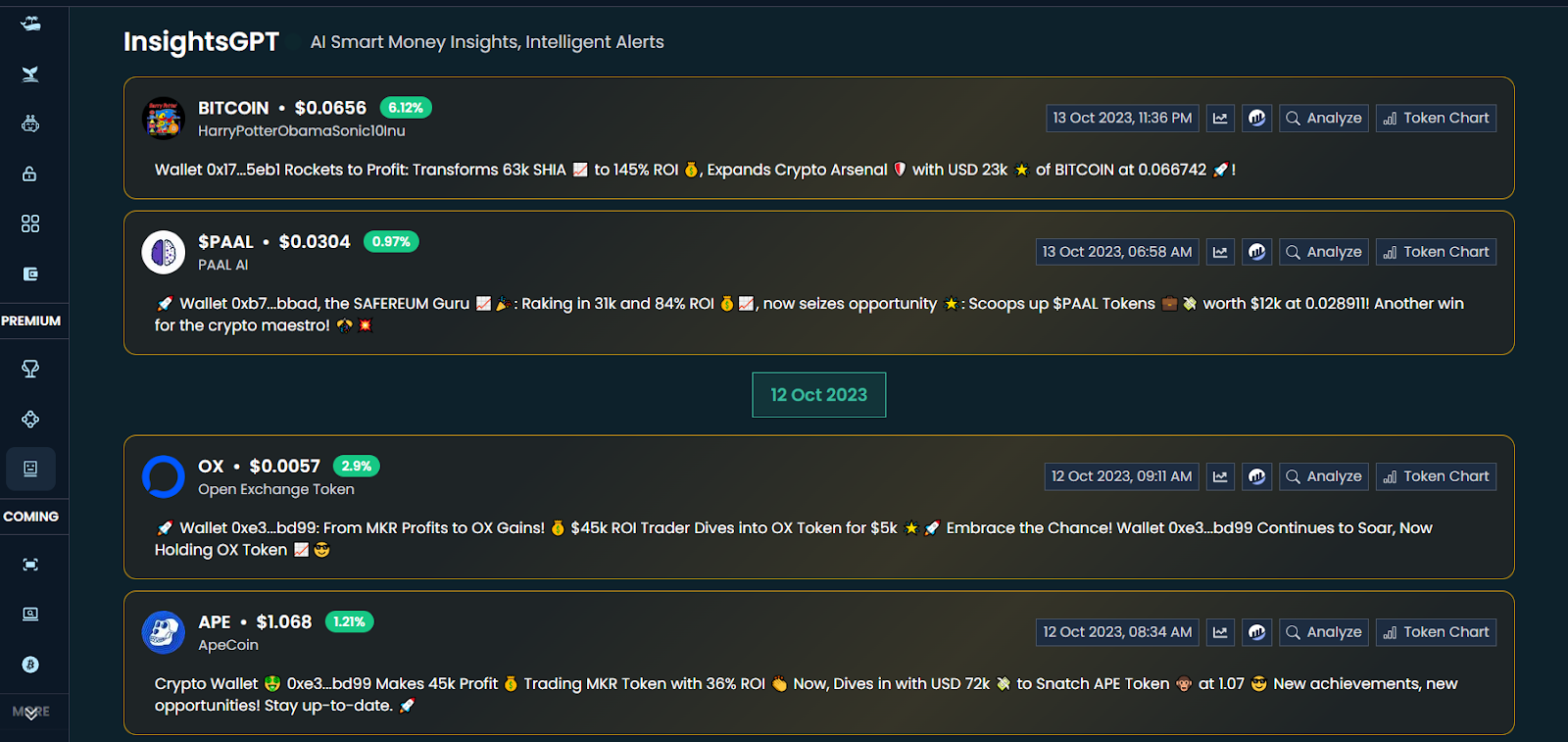
    An insightGPT alert takes this form,

    For any trader, this takes up the bulk of their copy trading process and gives them ample time to follow up with the most experienced traders in the market. InsightGPT combines the functionalities of wallet analytics and whale tracker applications and employs artificial intelligence algorithms to develop a compact data machine. The Artificial Intelligence arm of insightGPT is schooled on the best trade moves and the core signs of an experienced trader. Just like most other AI-powered applications, InsightGPT is in evolution. While the current stage is quite impressive, it will be interesting to see how the DexCheck team hones the application to adapt to even newer trading moves.

    How to use InsightGPT for your trading.

    Click here to access the application on the DexCheck Platform

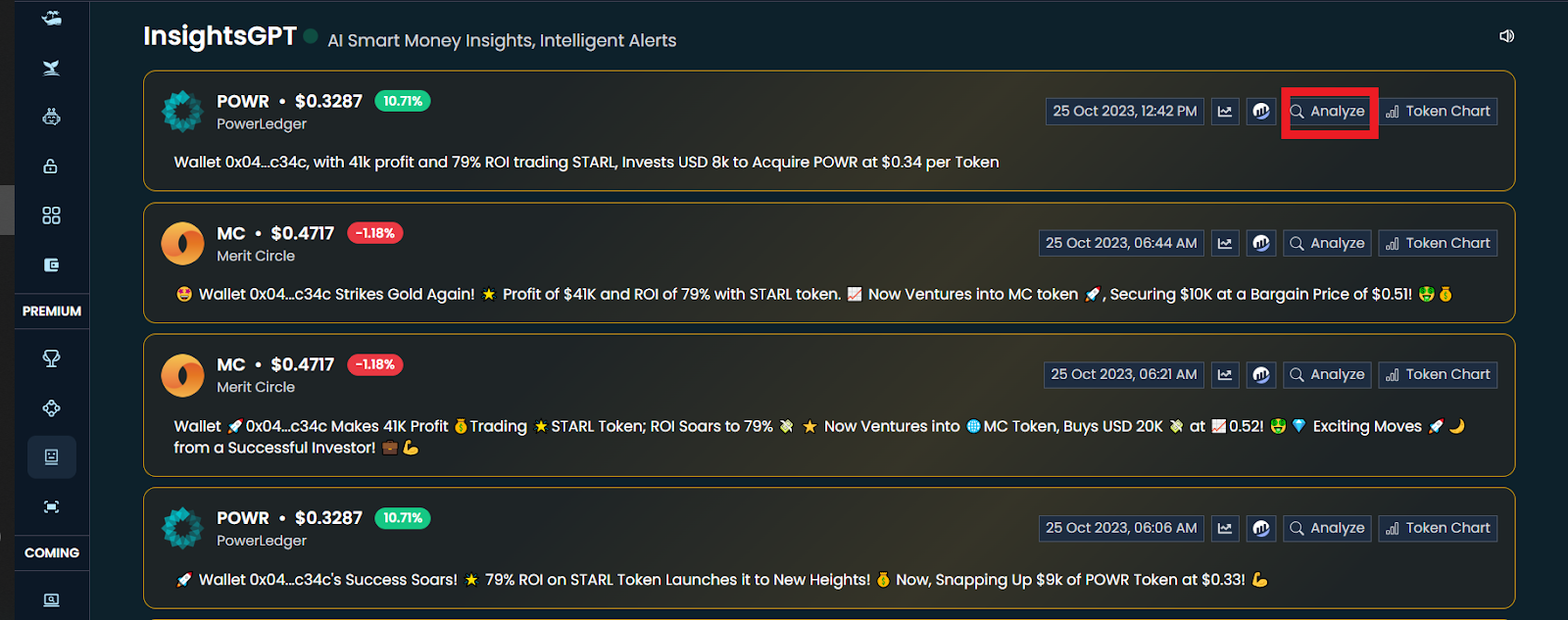
    The InsightGPT interface is real-time and newer information is shown as soon as the application detects, you can follow up on a specific trader or simply screen through the sniped addresses.

    You can also run analytics on a trader that interests you. To do this Click Analyze from the top right corner.

    This takes you to the Wallet analyzer interface for the address. Here’s how to navigate the wallet analyzer interface;

    How to use the Wallet Analyzer.

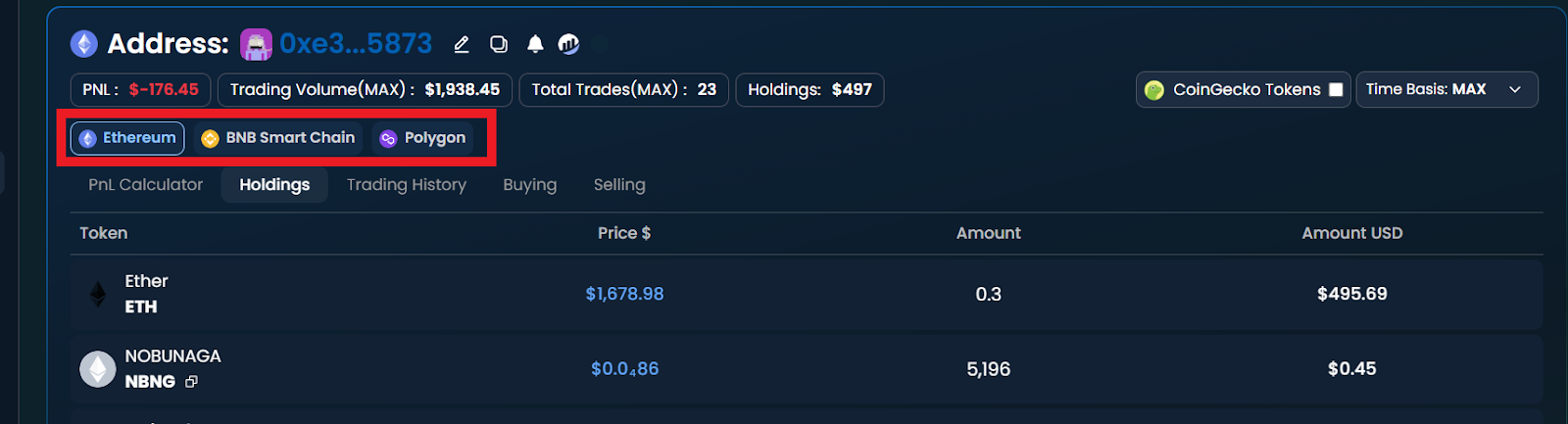
    First, the network section presents a list of blockchain networks where the address is active. 

    You can navigate to the different networks by simply clicking on them. The analyzer presents information for the selected network Only.

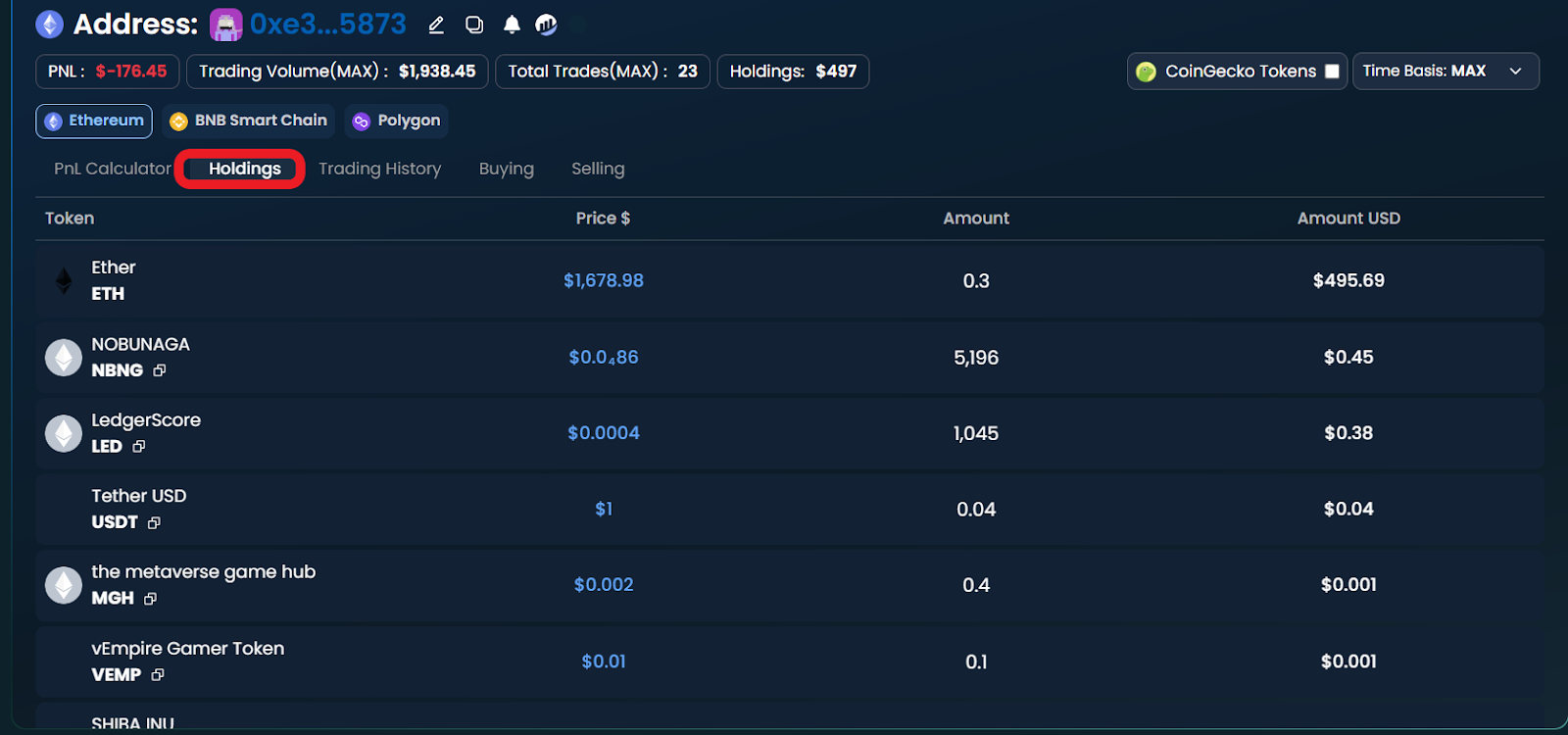
    On the Top section of the wallet analyzer page, you can see the calculated PnL for the address, the total volume of trades made on the selected network, and the total value of the asset in the wallet’s custody.

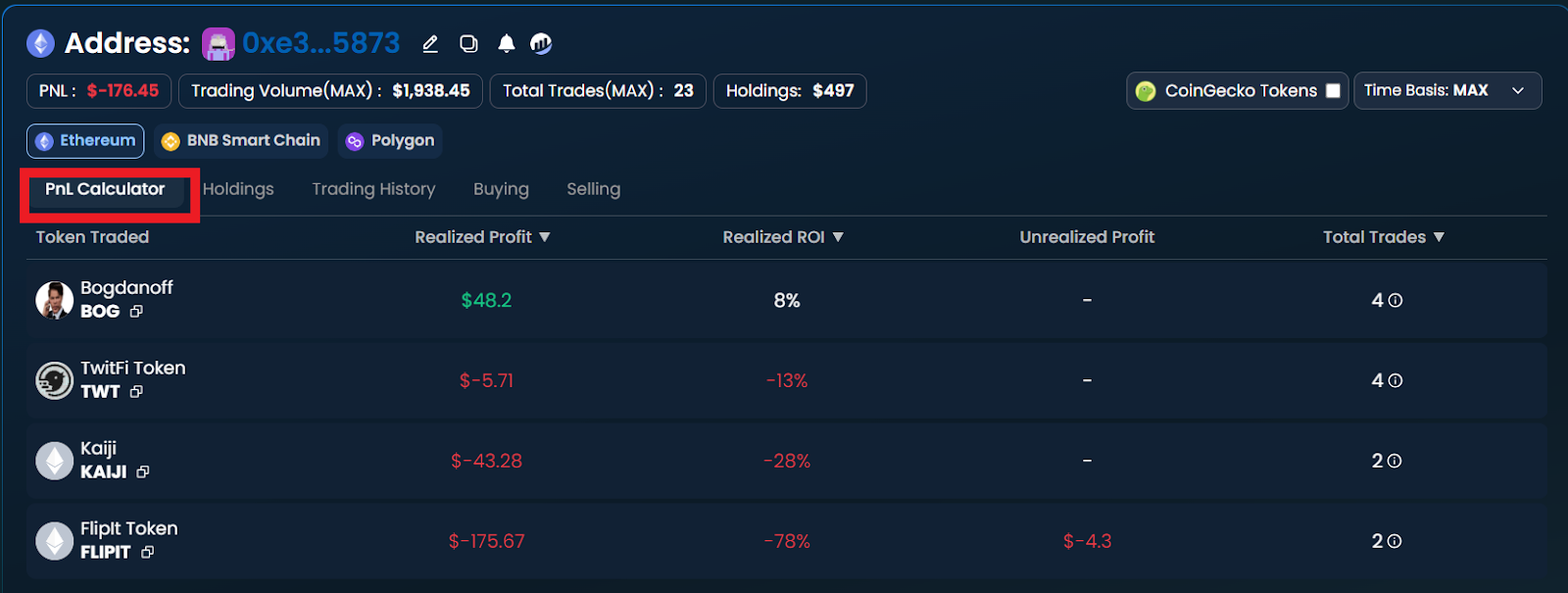
    The page usually opens to the PnL calculator, otherwise, navigate to the PnL section by clicking PnL calculator from the options in the left corner. 

    The PnL page presents the profit and loss the address has across different trades on the selected network. You can see a detailed breakdown of each trade and the profit or loss generated for the trade(s)

    To see a breakdown of the assets in the trader’s custody, click Holdings from the menu to navigate to the Holdings section. Here you will see assets the trader is invested in. if you wish to limit the presented assets to assets listed on Coingecko only, check the box next to Coingecko Tokens in the Top right corner.

    The Trading history, the Buying, and the Selling section show a further breakdown of trades by the wallet. You can navigate to these sections to obtain detailed information on the separate transactions.

    Setting up a notification

    You can set up notifications to follow a wallet closely. The Notification feature is a function of the DexCheck Telegram wallet-checking bot.

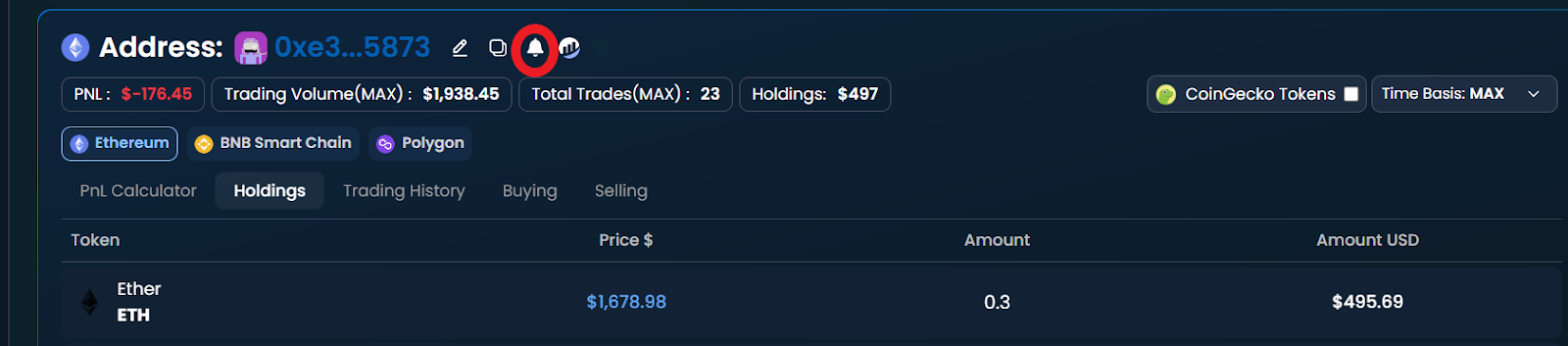
    To use this, click the bell icon from the top section, beside the wallet address.

    This should immediately open your Telegram messenger or request permission to open the Telegram messenger.

    We covered the control procedures for the Telegram wallet tracker bot. Check out this article for the Wallet Tracker bot guide.

    You can now set up a notification for the wallet and get a push notification on your device when the wallet makes a trade.

    SmartFolio

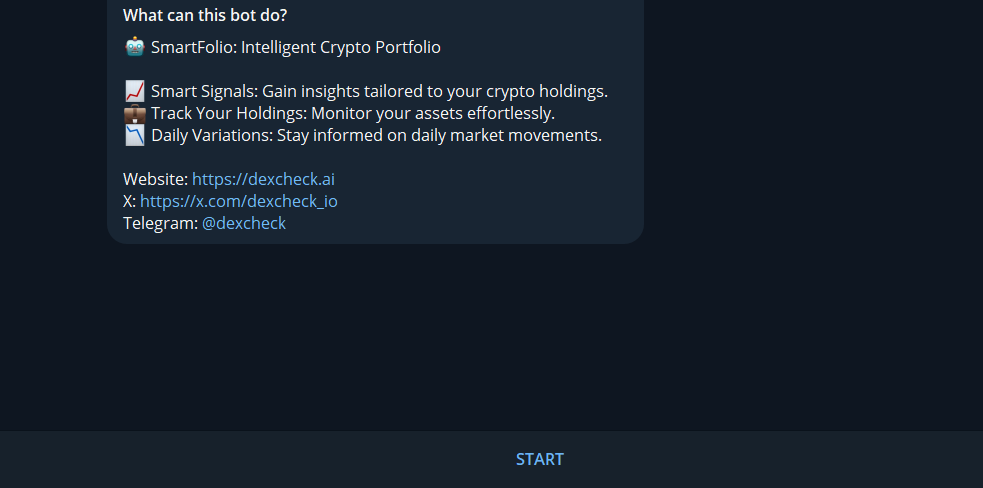
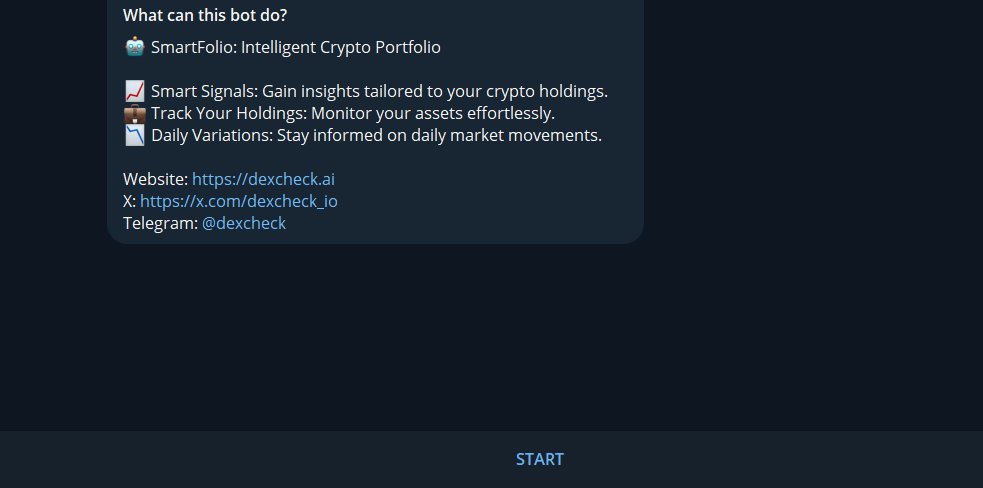
    Smartfolio is your intelligent portfolio manager and investment assistant, it is a Telegram bot that helps you track your investments and updates you with signals and price movements as it concerns assets in your wallet. You can integrate your wallet into the bot or manually add the assets you are invested in.

    Here’s how to manage your portfolio using the Smartfolio Bot

    Click here to navigate to the smartfolio section

    This automatically opens the Telegram Bot.

    Click Send Message to open the Telegram messenger

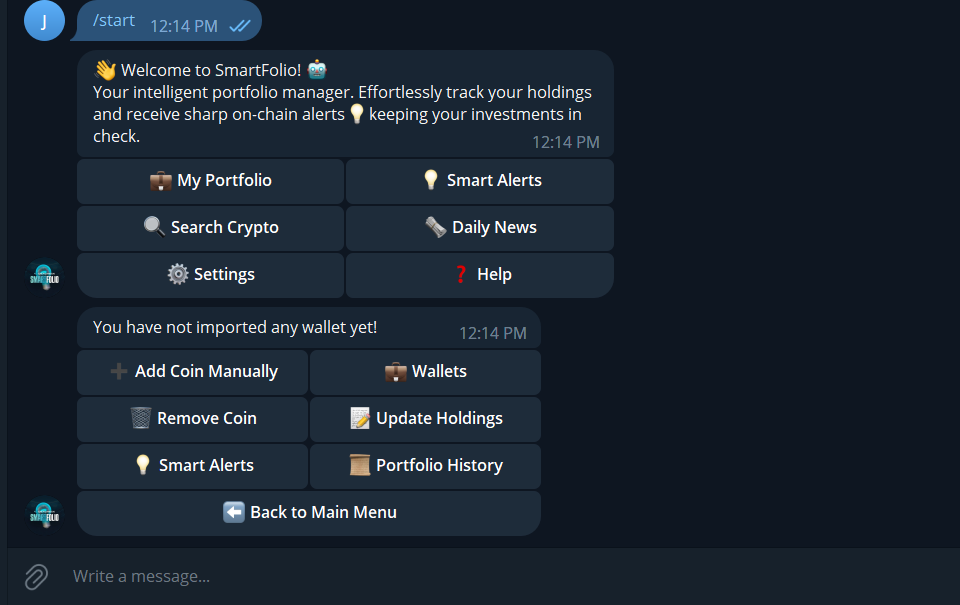
     Click Start to continue

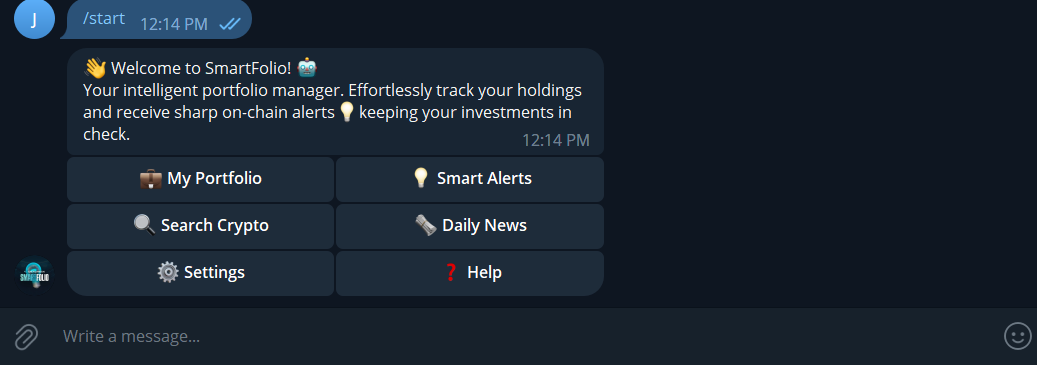
    Click My portfolio to add asset

    This returns a message with an option to import your wallet or track the asset manually

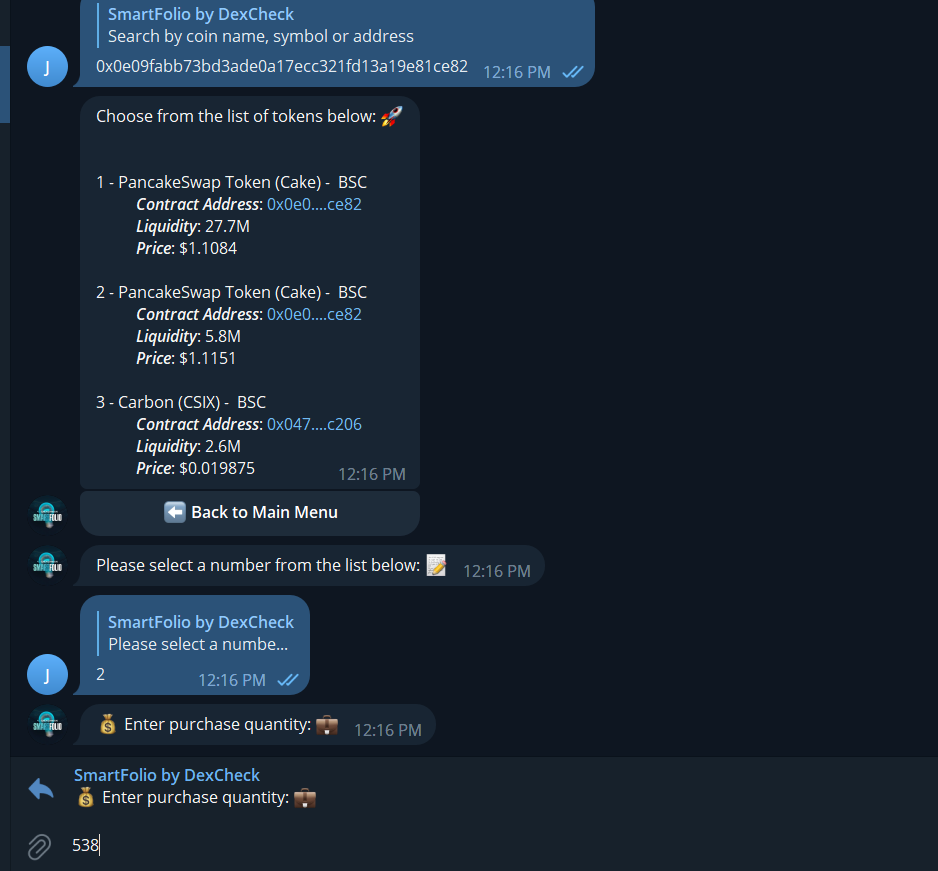
    To track assets manually, click Add Coin manually.

    Enter the Smart contract address or the name of the coin you wish to track

    The Bot presents a list of similar assets, Choose a line number that applies to the asset you wish to track

    Now enter the amount of the asset you own. Send to complete.

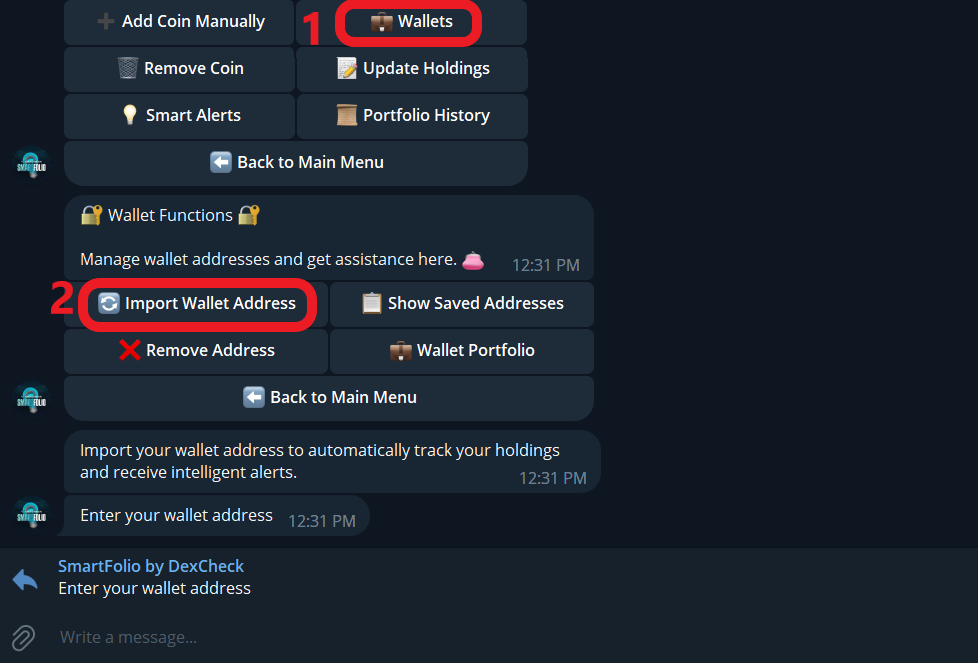
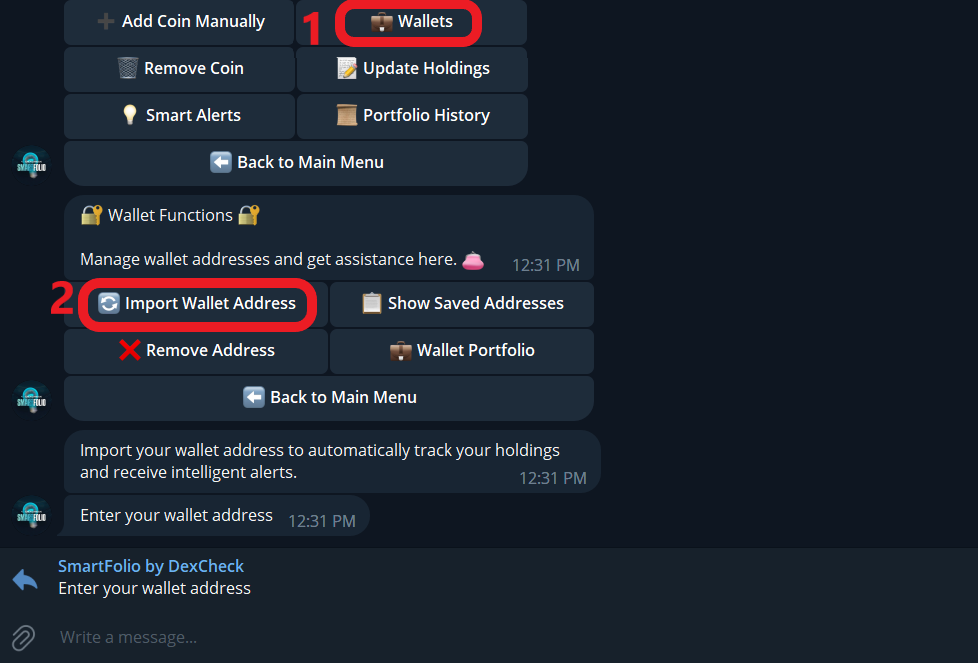
    To add import your wallet, Click  Wallets from the menu.

    Click Import Wallet address to continue

    Enter your wallet address and send

    The bot now tracks the assets in your wallet

    Click My Portfolio from the Main menu to see assets

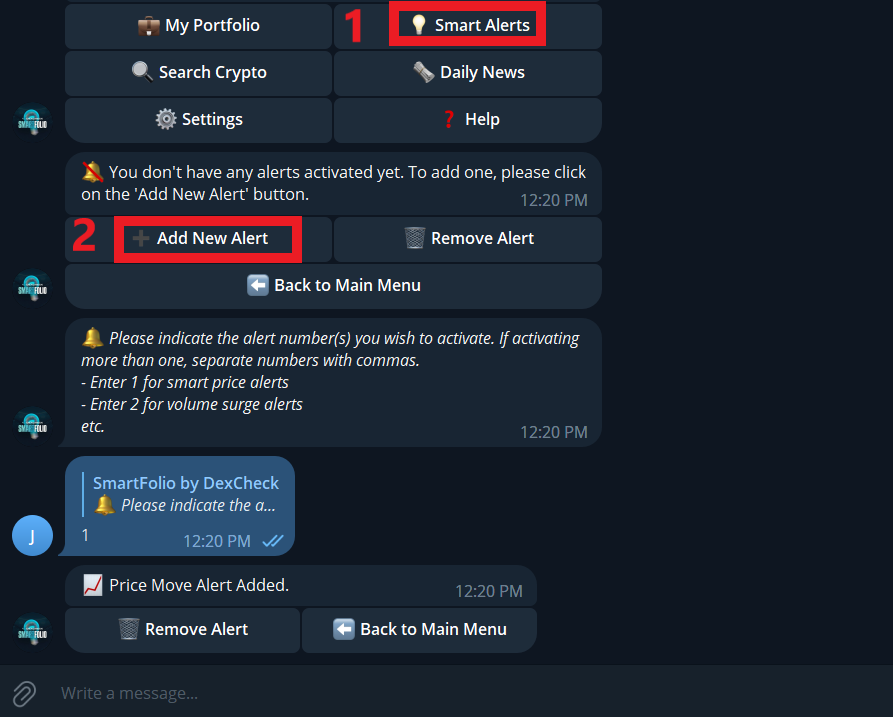
    To set up an alert

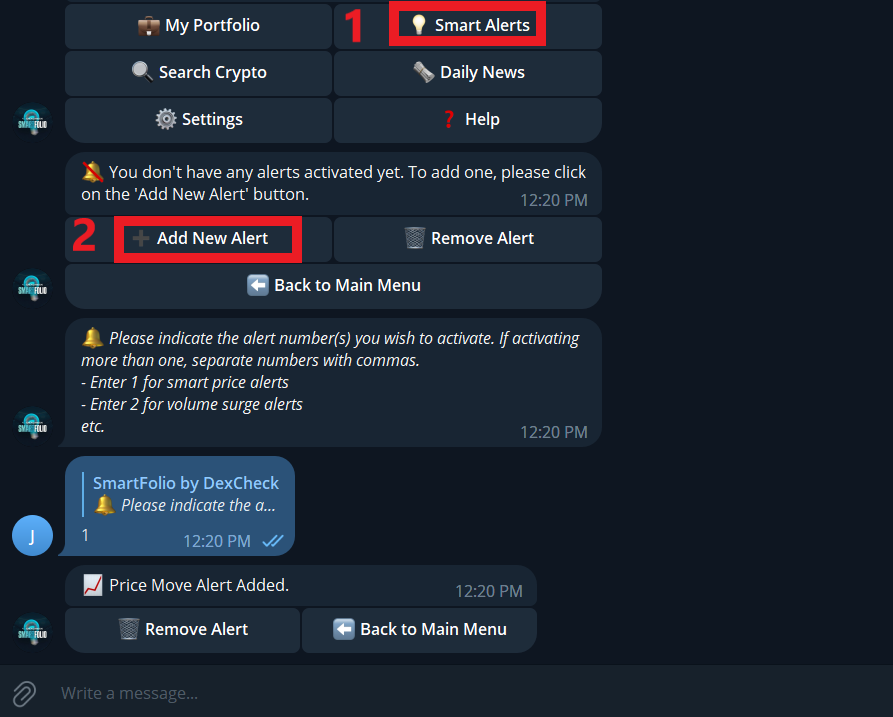
    Click Smart Alerts from the main menu

    Click Add New Alert.

    Enter the line number for the alert you wish to set.

    You will receive alerts as it applies to your choice.

    Top traders (for fungible tokens and NFTs)

    The top trader’s features are another quite interesting application available to pro traders only. Like InsightGPT, it is a data-driven machine as well, however, it gets quite interesting. Instead of presenting the data on interesting trades separately, the top traders’ feature collates high positive PnL traders and traces these trades down to the maker, then it runs a calculation on the total profit and loss generated by the trader. It then shows on the interface, the traders with the highest gains over a specific period of time. This feature is flexible, you can adjust the timeline for the calculations and filter your searches to narrower data. The Top Traders application (for fungible tokens) supports over 20 blockchain networks and 30 decentralized exchanges

    The interface is quite intuitive and also has a link to the wallet analyzer to allow you to perform deeper studies on the trader.

    Here’s how to use the top traders feature (for fungible tokens)

    How to Identify Top Crypto Traders Using DexCheck

    Click here to navigate to the Top Traders application.

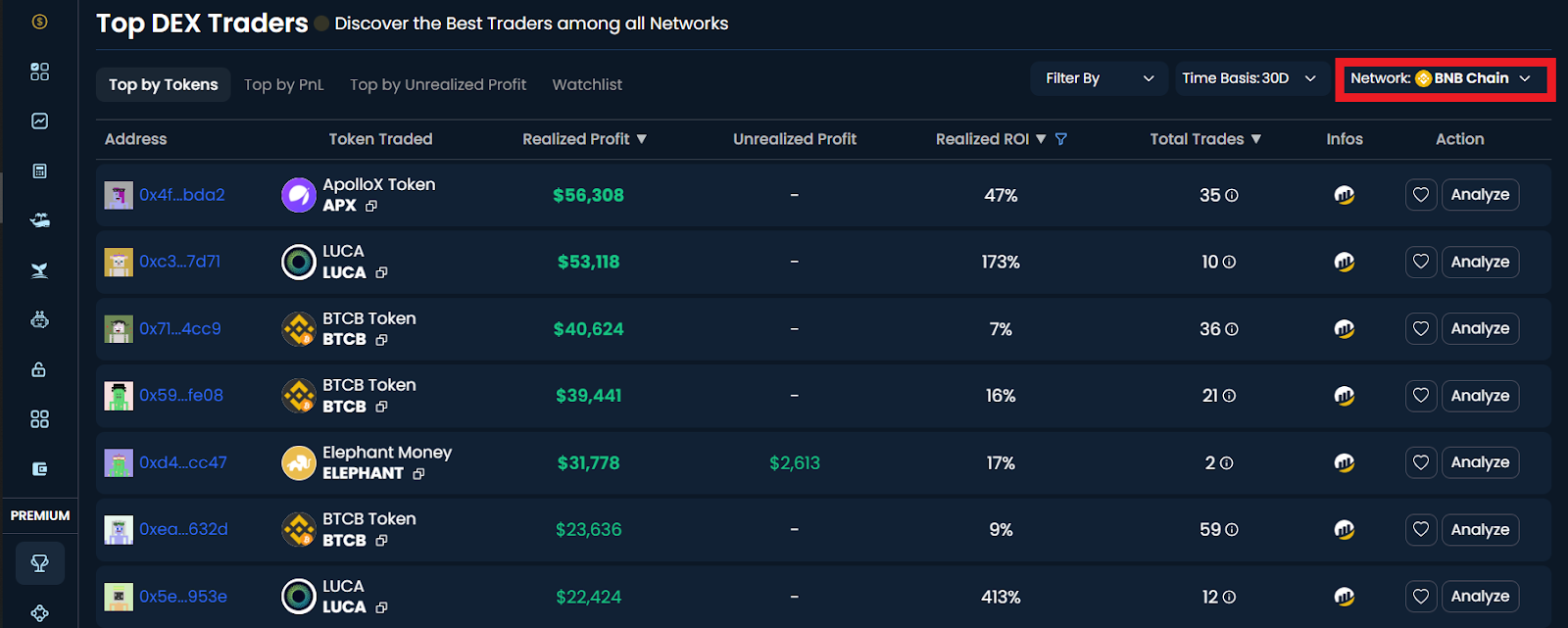
    The list is set to a specific network, Click the Network section from the top right corner to select a desired network.

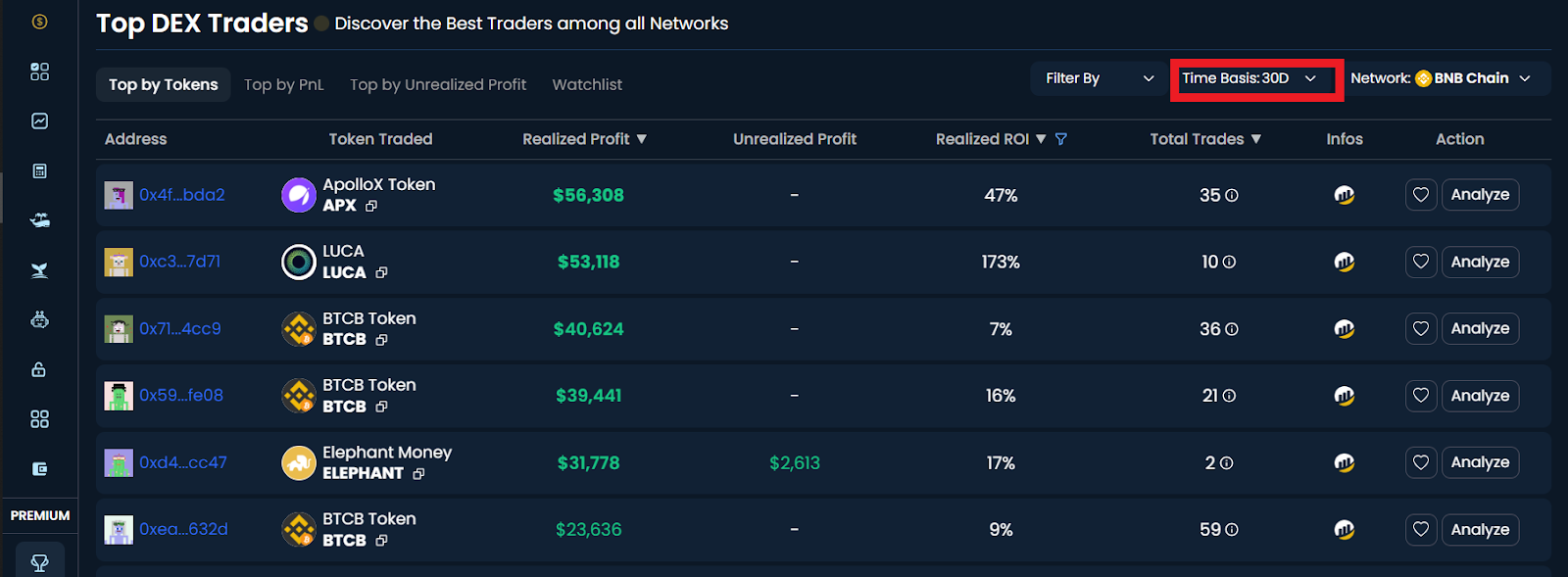
    You can now see the list of traders with the most successful trade on the network. This is initially set to 30 days period.

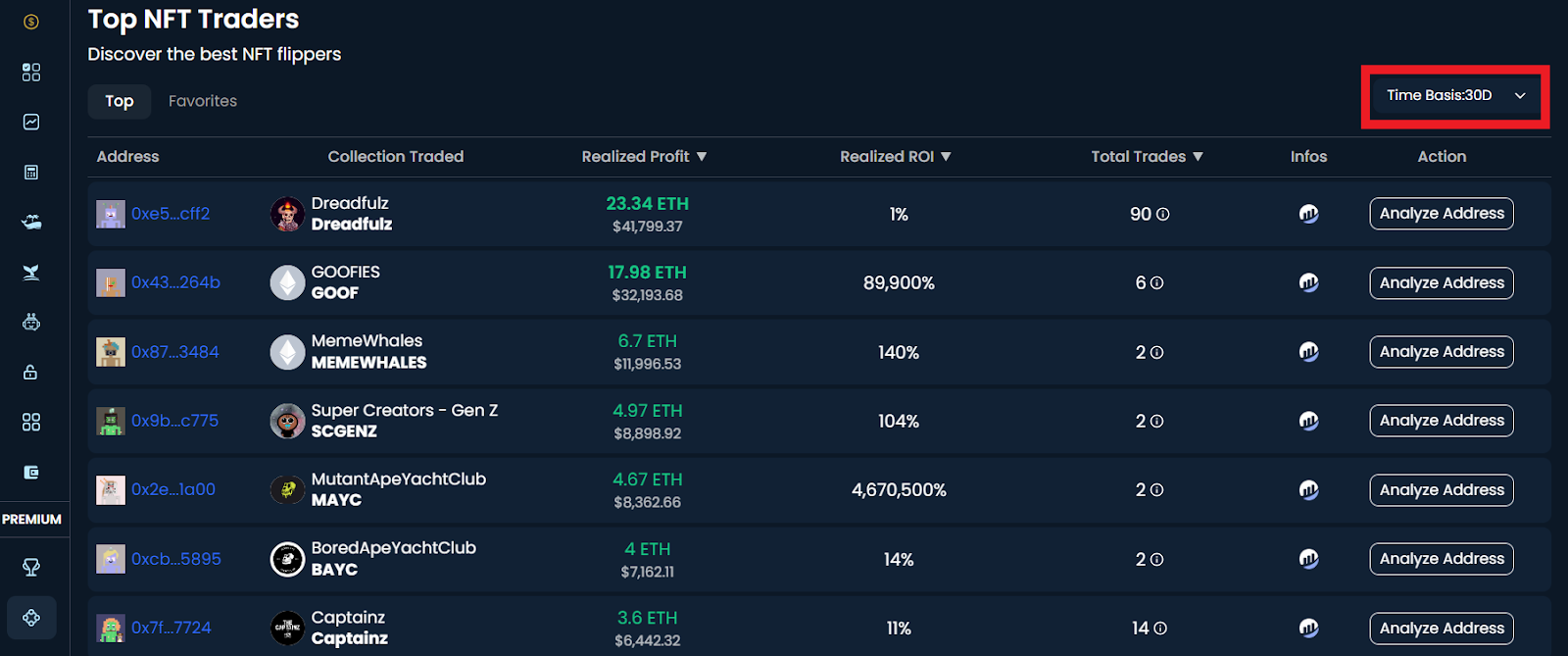
    To change the period, Click on Time Basis, you can set it to 7 days or 24 hours.

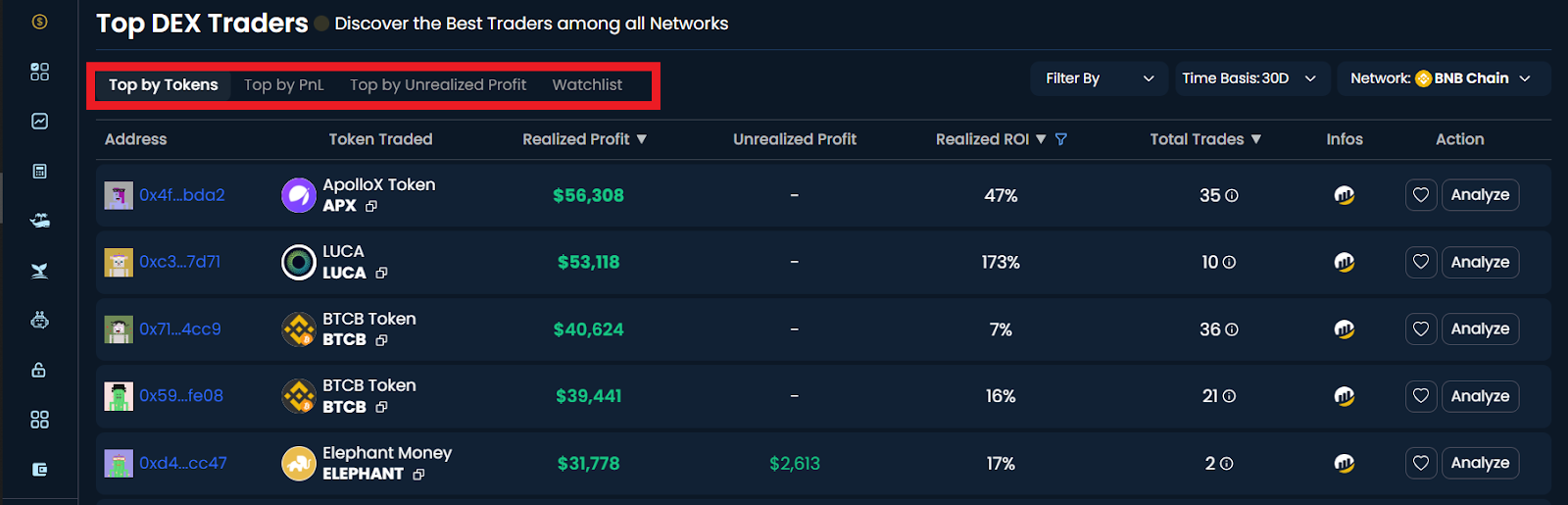
    You can also arrange the list according to the Traders’ PnL and unrealized profit. Click on any of these as shown above.

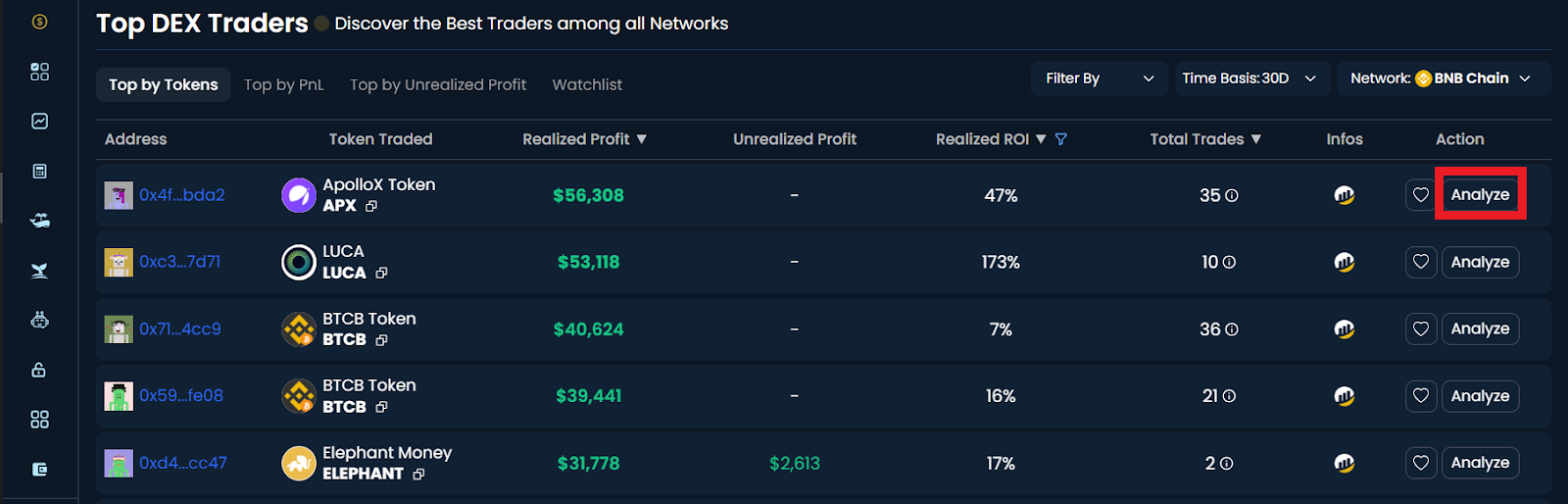
    To run a deeper analysis on the wallet, Click Analyze from the right corner to access the wallet analytics page for the address. Follow the wallet analyzer guide above to navigate through the wallet analyzer interface.

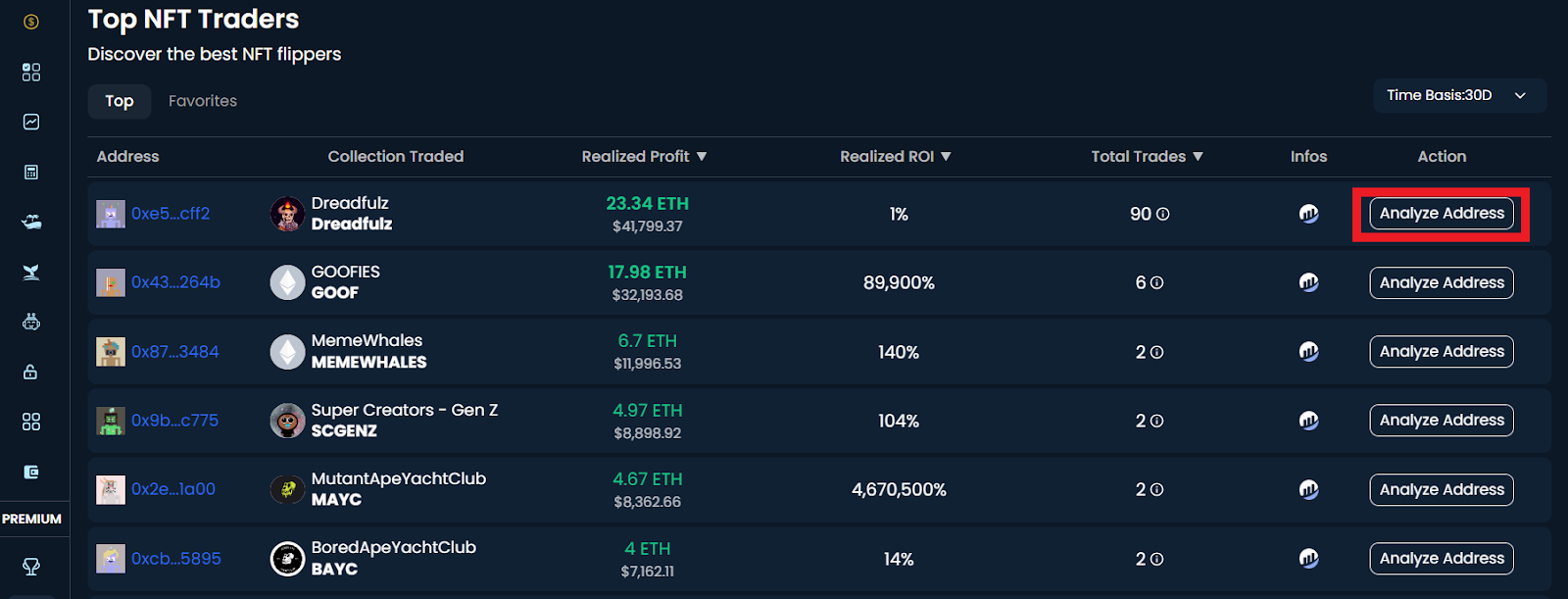
    How to Identify Top NFT Traders on DexCheck

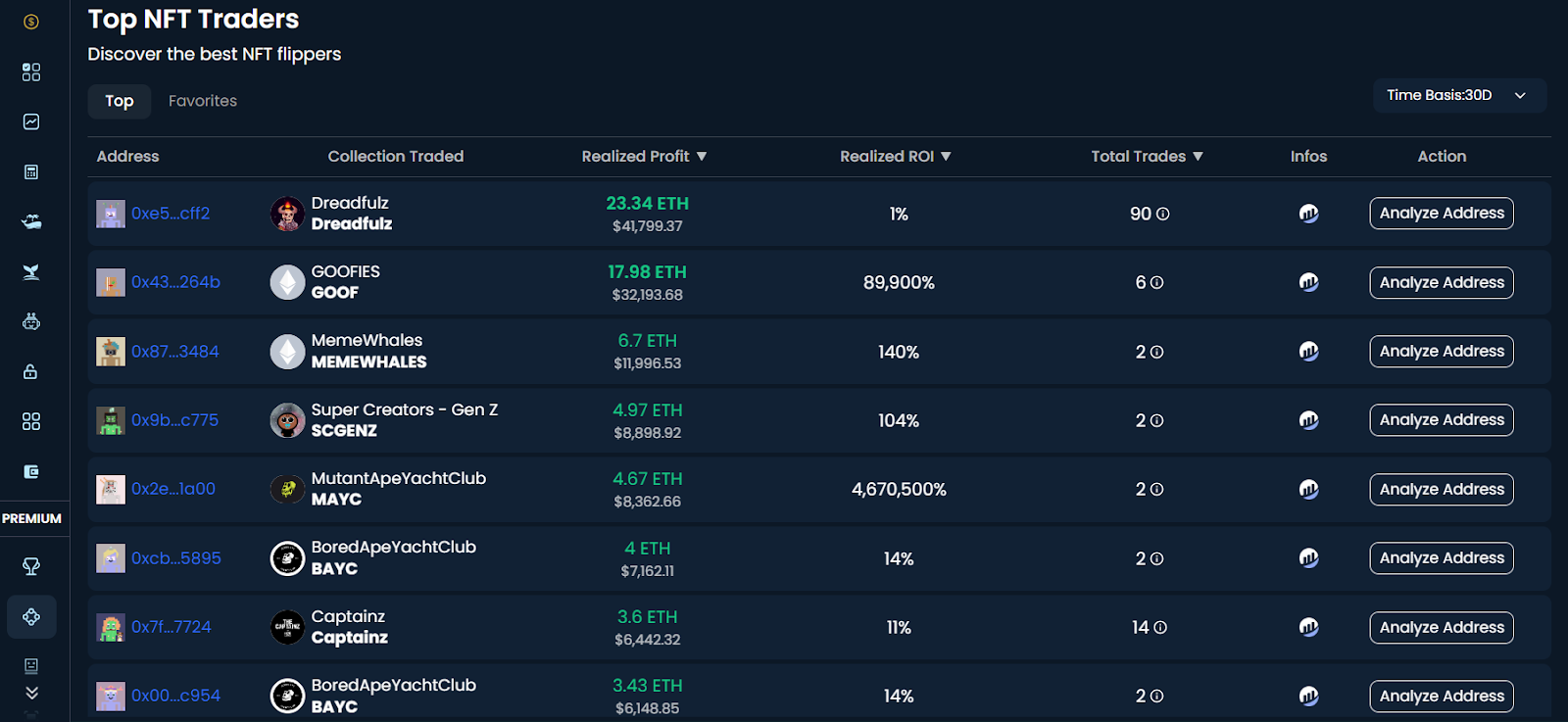
    Flipping an NFT for some profit isn’t really as easy as it appears, but some popular NFT traders have mastered this trade and constantly print profits in their NFT trades. As a newbie and regardless of your expertise in the sector, following up traders with a recurring record of profitable trades can improve your performance as well. With the DexCheck Top NFT Traders application, this is much easier.

    The Top NFT Trader application works in a similar fashion as the Top Crypto Traders application, but it tracks NFTs instead. Also, the Top NFT Traders application only supports the Ethereum network at the time of writing.

    To use the Top NFT Traders application;

    Click here to navigate to the application

    The landing page lists NFT traders with the most profits in a period of time. Click the duration box in the top right corner to change the duration.

    To run a deeper analysis on any of the traders, click Analyze Address from the top right corner.

    The wallet analytics page for NFT traders is similar to that of crypto traders. Refer to the wallet analyzer guide above to navigate through the wallet analyzer interface.

    Closing Thoughts

    We could see traders raving about insightGPT, this is quite understandable, the lead it gives the everyday trader is handy, but the underlying technology is even more impressive. It is likely that we see this tool develop into a more capable application. However, the Smartfolio comes close in terms of utility. By being integrated into the telegram messenger, it delivers its role perfectly. Still, one to keep tabs on as the project develops. The Top Trader feature might also fall down the pecking order as InsightGPT continues to evolve. Either way, it is still a handy tool.

    The point here is, looking at the utilities of the pro trader features and how accessible they are, every trader should consider trying these out. Even better, newer features will be available to pro traders.

    We have covered a few aspects of DexCheck from the technological point of view. Check out some of these articles

    A definitive Guide on how to use the DexCheck Telegram bot.

    How to perform on-chain analysis using DexCheck Analytics tools.

    For more resources

    Follow DexCheck on X

     Available utilities on the DexCheck Platform

    Join the Telegram community

  • How to perform on-chain analysis with the DexCheck wallet analyzer and token analytics tool

    How to perform on-chain analysis with the DexCheck wallet analyzer and token analytics tool

    I recently published a complete guide on DexCheck Telegram bots and here are a few things you need to know about these bots before moving on to the main topic of this article;

    • These Telegram bots can cut your crypto investment hassles by over 30%
    • The bots are not just convenient but they are quite comprehensive. You perform a good number of operations by common intuition.
    • Over a thousand cryptocurrency investors trust DexCheck telegram bots and the number is growing.
    • The sniper bot is currently in development and will complete the DexCheck Telegram bot Trinity.

    Interested? Check out the guide on how to use the DexCheck Telegram Bots to get started.

    Having said that, his article will go a bit further to demonstrate how you can perform on-chain analysis as a cryptocurrency trader using some utilities offered by DexCheck on its platform.

    Why DexCheck on-chain analytics tools?

    Investing in cryptocurrency can be tricky, the space is significantly different from other investment spaces. One of the major differences is the access to extensive information from tracking and computing data from the blockchain. Crypto asset movements are recorded on the blockchain and these data cannot be manipulated. Investors can improve their chances of making a profitable trade by using these information on the blockchain, strategically. This isn’t obtainable in mainstream investment spaces, especially in stocks and bonds trading.

    But here’s a catch, while these information are readily available, computing them the right way is quite a tedious task and most investors run into errors in their computations and subsequently, make wrong trading decisions. This is where the DexCheck wallet on-chain analytics tools come in.

    How DexCheck on-chain analytics tools work

    DexCheck on-chain analytics tools connect the blockchain, obtain data, and compute them using pre-integrated algorithms to generate more useful data for users. These data are then presented in user-friendly interfaces and augmented with single-click action buttons to enable investors to make quick decisions from the presented data.

    DexCheck’s wallet analyzers include whale trackers and information on top traders for a specific time. The DexCheck whale trackers present information on high-value trades across decentralized exchanges. This is flexible, users can set the price they consider ‘high-value’. The wallet analyzer collates information on the traders, these information includes all recent trades, PnL (profit and loss) data, and the crypto assets in the trader’s custody.

    The wallet analyzer supports up to 20 blockchain networks including Ethereum, Polygon, Binance Smart chain, and Fantom network.

    Here are some operations you can perform with this application.

    Token Analytics

    The Token Analytics tool gives traders detailed information on any token traded actively on decentralized exchanges. it provides information on the trades and the smart contract. You can also use the embedded charting tool for your TA analysis.

    How to analyze tokens with the DexCheck Token Analytics tool

    Click here to access the token analytics tool on the DexCheck application.

    The app opens up the scan section automatically. You can locate the search bar at the top of your screen.

    DexCheck token analytics

    To analyze any token, simply copy and paste the token’s smart contract into the search box and send.

    DexCheck swap

    On the token’s page, you can find the smart contract information on the left-hand side of the page for Desktop devices. This shows the security and ownership details of the smart contract token.

    To access the smart contract scan section on mobile devices, click on Scan as indicated in the screenshot above.

    The smart contract scan feature is provided by DexCheck in collaboration with Gopluslab. You can ascertain the safety of a token and the risks of a rug pull through the scan feature.

    Trading information

    The trading information of the token can be located in the lower part of the page, for mobile and desktop devices.

    Scroll down to find the recent trades and their details.

    The trading information section presents these details in sections. The Buyers section shows purchase transactions only while the Sellers section shows the sale transactions only.

    To analyze individual trades that you may find interesting, Click Analyze Address from the right-hand side to get more information on the trade and the maker’s address.

    You can also obtain the holders’ information from this page. Navigate to Holders to obtain valuable information on the token holders.

    The smart money section is also a handy tool in the Trading information section. It presents information on some successful trades for the token. You can see the trader’s wallet address and the PnL data. You can also gain more information on the address by clicking Analyze Address from the right corner.

    Navigate to Smart Money to use this feature

    Making a sale or purchase

    To trade the token from DexCheck’s interface, navigate to the Swap section from the top left corner of the page.

    Your wallet must be connected to the page to use the swap feature. Click Connect from the swap interface or from the top right corner to connect your wallet

    Now set up your trade and Click Swap to buy or sell the token. 

    Extra tools in the token Analytics sections are the charting tool and the converter. The charting tool is adapted from Trading View and shows a graphic record of the asset’s price development. For traders who are conversant with TA analysis, this tool is a complete charting tool and is available for any asset.

    The converter tool can also be used to simulate the exchange rate of the token against other assets. the FAQ section located in the area also answers some usual questions about the contract token being analyzed.

    Wallet Analytics

    Next on the list of utilities on DexCheck is the wallet analytics feature. The wallet analyzer is an on-chain data collection application tailored for individual wallets. It obtains on-chain data for presented wallets and delivers to users, untampered information directly from the blockchain records. The wallet analyzer currently supports about 30 decentralized exchanges and 10 blockchain networks including Binance Smart Chain (BSC), Linea layer-2 network, Polygon, Fantom, and the Avalanche blockchain.

    The Analyzer screens the wallet for its activity on any of the supported decentralized exchanges and networks. The provided information is optimized for traders and the interface allows the user to perform quick actions. Here’s how to use this application;

    How to run on-chain analysis on a wallet address using the DexCheck wallet analyzer

    Click here to visit the wallet analyzer application on the platform

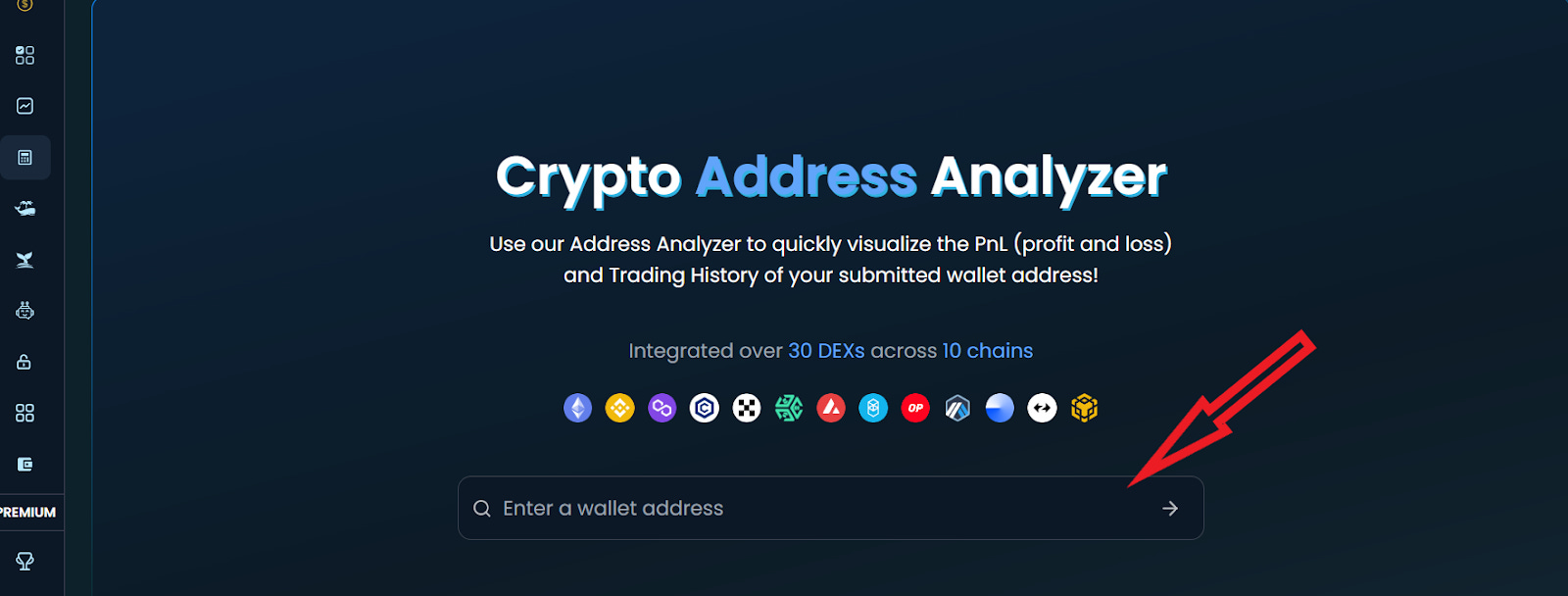
    On the landing page, you can enter the wallet you wish to analyze into the search box.

    Send to continue

    The address page features different information sections. Let us take a look at some of them

    Wallet analyzer features

    First, the network section presents a list of blockchain networks where the address is active. 

    You can navigate to the different networks by simply clicking on them. The analyzer presents information for the selected network Only.

    On the Top section of the wallet analyzer page, you can see the calculated PnL for the address, the total volume of trades made on the selected network, and the total value of the asset in the wallet’s custody.

    The page usually opens to the PnL calculator, otherwise, navigate to the PnL section by clicking PnL calculator from the options in the left corner. 

    The PnL page presents the profit and loss the address has across different trades on the selected network. You can see a detailed breakdown of each trade and the profit or loss generated for the trade(s)

    To see a breakdown of the assets in the trader’s custody, click Holdings from the menu to navigate to the Holdings section. Here you will see assets the trader is invested in. If you wish to limit the presented assets to assets listed on Coingecko only, check the box next to Coingecko Tokens in the Top right corner.

    The Trading history, the Buying, and the Selling section show a further breakdown of trades by the wallet. You can navigate to these sections to obtain detailed information on the separate transactions.

    Setting up a notification

    You can set up notifications to follow a wallet closely. The Notification feature is a function of the DexCheck Telegram wallet-checking bot.

    To use this, click the bell icon from the top section, beside the wallet address.

    This should immediately open your Telegram messenger or request permission to open the Telegram messenger.

    We covered the control procedures for the Telegram wallet tracker bot. Check out this article for the Wallet Tracker bot guide.

    You can now set up a notification for the wallet and get a push notification on your device when the wallet makes a trade.

    Why asset tracking?

    Trading experience differs from one trader to another, this is the same for exposure to information. Depending on the extent to which a trader has these two, they are bound to make more informed decisions. For other traders, one way to benefit from traders like this is to follow their trades and trade along. Centralized exchanges and advanced trading platform has the Copy trading feature, but this is a bit different from what can be achieved by tailgating a trader.

    Other traders can not only follow their immediate trades but also move to purchase and hold the assets held by these wallets in anticipation of gains. While there are no assurances in cases like this (like any other trading strategy), investors have, at most times claimed that this strategy works. Therefore, when a trader obtains the wallet address of another (successful) trader, they can use the DexCheck analyzer to check their activities and also set up an alert system to notify them of subsequent moves by the wallet.

    Whale Tracking (for NFT and Fungible tokens)

    DexCheck whales tracker detects big buy or sale transactions for crypto assets, including NFTs. Using this application, investors can easily see the big movers and follow their trail.

    Why whale watching? Whale watching in the crypto space is similar to the usual whale watching; trailing the biggest entities. However, the goal is different. Whales are entities of interest, from the buy side and the sale side. The big holders and big movers are sometimes considered the most informed investors, but this isn’t always the case, however, their moves are always of high impact.

    But using DexCheck’s whale trackers investors can easily find ‘informed whales’ and follow up with them. The Whale tracker is able to do this by showing the trader’s history. A big mover with a higher record of successful trades against losing trades is considered an informed whale. Here’s how to use the DexCheck whale tracker

    How to Track a crypto whale using the DexCheck Crypto Whales Tracker

    Click here to access the DexCheck crypto whales tracker.

    On the landing page, the application shows a list of high-value trades and their details. The information shown on the landing page includes the asset traded, the DEX where the trade occurred, and the activity (buy or sell)

    The whale tracker tracks one network at a time but up to 20 blockchain networks are supported.

    To track whales on a different network, click the caret in the network area at the top right corner of your screen.

    Check the box beside the network you wish to track whales in.

    To get more information on a particular whale, click Analyze Address on the right corner of the whale’s transaction. This opens the wallet analyzer page for the address.

    You can refer to the wallet analyzer guide above to guide you through basic operations on this page.

    How to use the DexCheck NFT whale tracker

    The NFT whale tracker is currently available for the Ethereum blockchain only. Anyways, this could change in the future. The whale tracker collates big NFT purchases across Ethereum NFT marketplaces in real time and presents details of each trade. This includes the wallets that participated in the trade, the value of the NFT trades, and details of the collection.

    To use this

    Click here to access the NFT tracker section

    On the landing page, the transaction details are shown

    You can get more information on the traders by clicking their wallet address from the landing page.

    You can also hover your mouse over the number in the Info section to get an insight into the trading history of the NFT.

    The NFT tracker will certainly get more features and probably track NFT trades on more networks. The current features allow an overview of high-value NFT trades.

    Closing Thoughts

    The handy trading and investment planning tool is one that meets investors halfway in their operations through actionable insights and advanced metrics. DexCheck wallet analyzers go beyond this to offer easy implementation channels for the developed strategies. This, in synergy with other tools offered by the project, is focused on creating more successful investors through informed decision-making. It is not certain how traders use these tools individually as they are very flexible, but it is certain that if used properly, these tools will significantly increase an investor’s chances of making the right pick.

    We have demonstrated the basic operations with these tools and we admit that even this guide is not exhaustive of the operations available on the analyzer. Also, it is important to understand the provided while using them in your analysis. It is also advised that you apply risk-management strategies while trading. Do note that this guide is only meant to take you through how to use the application, and not to give financial advice.

    For more information on DexCheck and other applications, here are some handy resources:

    Check out the detailed guide on DexCheck’s Telegram Bots

    See the latest updates on X

    Available utilities on the DexCheck Platform

    Join the Telegram community

  • Transform your crypto investment with DexCheck’s Telegram Bots.

    Transform your crypto investment with DexCheck’s Telegram Bots.

    DexCheck Telegram bots

    DexCheck Telegram bot is a suite of trading tools you can operate from your Telegram messaging application. The bot is available for Mobile and Desktop versions of Telegram Messenger. Telegram trading bots are not a thing in crypto and you can find a number of them with little research, but the functionalities and accuracy could differ.

    I have been doing a continuous study on DexCheck and writing about my experience so far. The Telegram bot has been a handy one, for anyone trying out DexCheck’s Telegram Bot, here’s a detailed guide on how to use the features. Note that this article isn’t exhaustive of the Telegram bot application.

    Here are some of the features we will be trying out

    ● The DexCheck Multi-wallet crypto Trading bot

    ● DexCheck crypto wallet tracker bot

    ● Smartfolio bot

    ● The DexCheck Token Scanner bot

    First, set up the Telegram Bot

    How to setup the DexCheck Telegram Bot

    The Telegram Bot can be easily accessed from the DexCheck application or using the direct link to the bot.

    ● Here’s the Direct link to the Multi-wallet Trading bot: https://t.me/DexCheckTradingBot

    ● Here’s the Direct link to the crypto Wallet tracker bot: https://t.me/DexCheckWalletBot

    ● Here’s a link to the Smartfolio bot: https://t.me/thesmartfolio_bot

    ● Here’s the Direct link to the token scanner bot: https://t.me/DexCheckScanner

    If you are using the project’s website, Click here to visit the Telegram Bot section on the Platform.

    Here you can find all available Telegram Bots by DexCheck.

    From the featured bots, select a desired bot. Click on the bot to proceed.

    This opens a dialog on your browser, Click Send Message to open the Telegram Messenger.

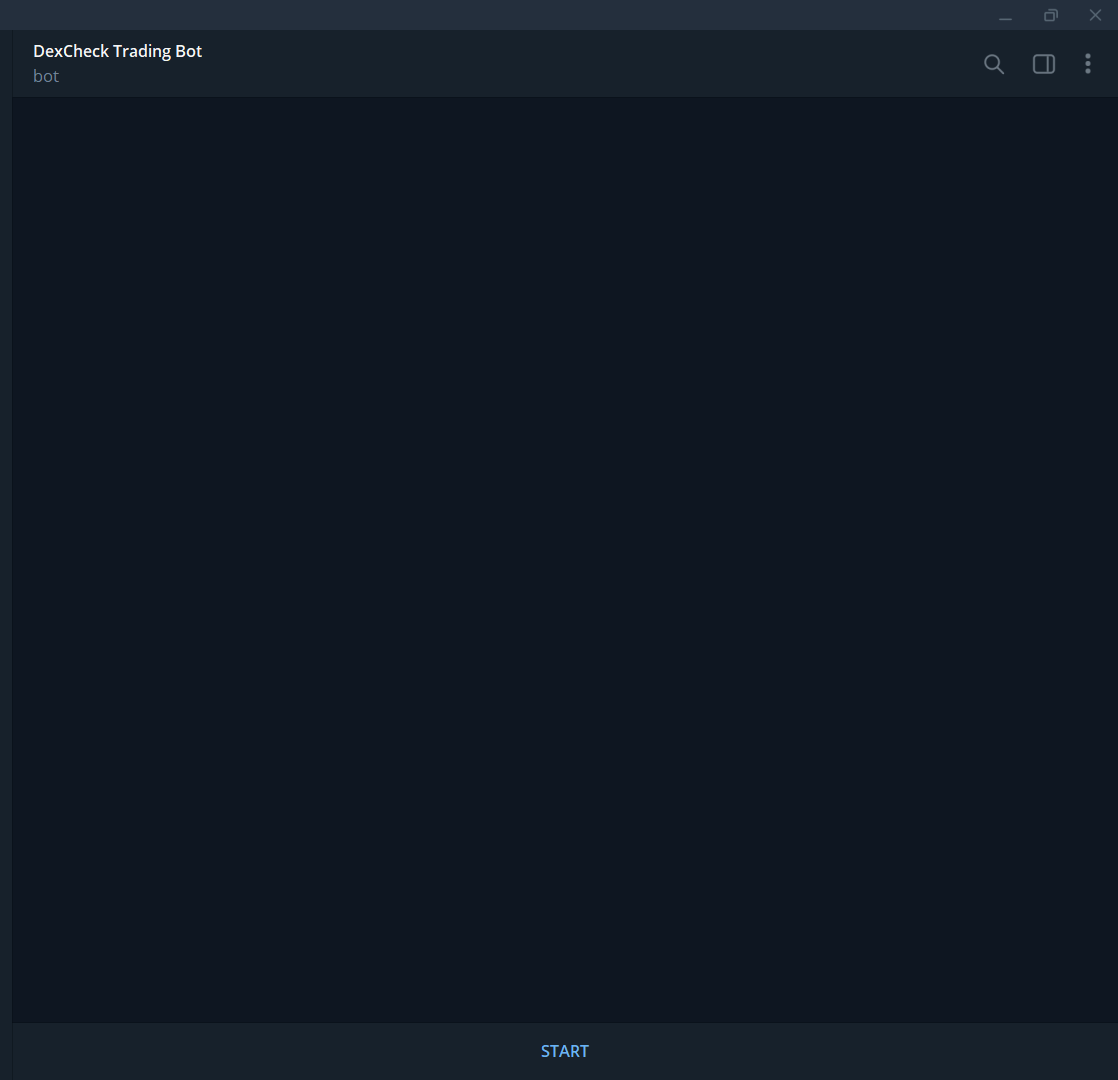
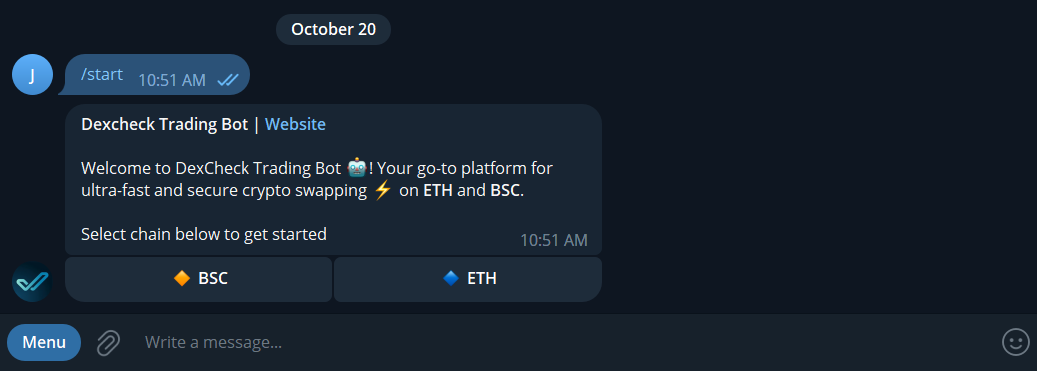
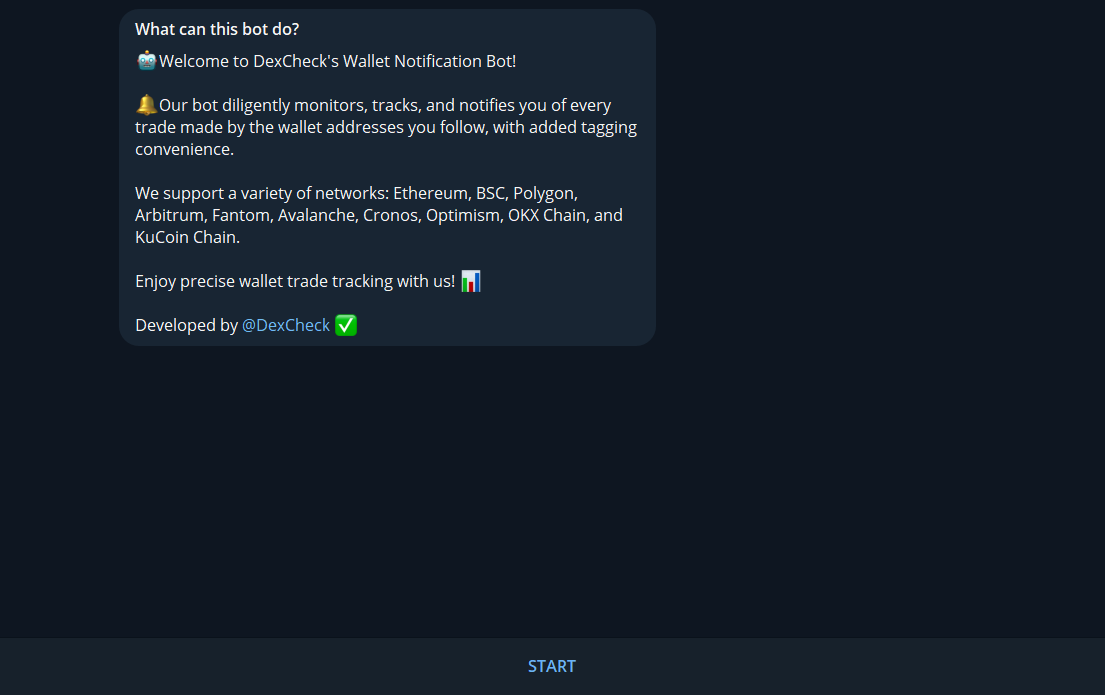
    On Telegram, Click Start to start interacting with the Bot.

    How to use the DexCheck Multi-wallet Trading Bot

    The Trading Bot is an integrated and simplified bot for traders who seek a more comfortable way to run their trading activities. The trading bot connects to decentralized exchanges to execute buy and sales for coins and tokens.

    The DexCheck trading bot also have limit order functionalities, you can set up a complete conditional sale or buy order from your Telegram messengers.

    To use the DexCheck trading Bot

    Click https://t.me/DexCheckTradingBot to Message the Trading bot

    Click start to continue

    Select a network

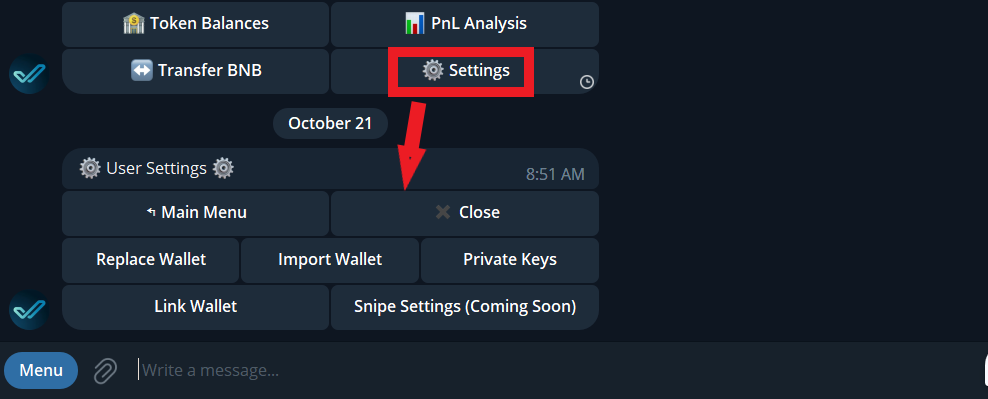
    The bot provides you with three wallet addresses. You have the option to use any of them for your trades.

    You can also export the wallets or import your old wallet to the Telegram Bot.

    To export/import wallet click Settings.

    Click Import Wallet to add an existing wallet to the bot

    Click Private Keys to see your wallet keys.

    You can export the wallets using the private keys

    Trading with DexCheck Telegram Bot

    Fund your wallet by transferring BNB to the provided wallet address

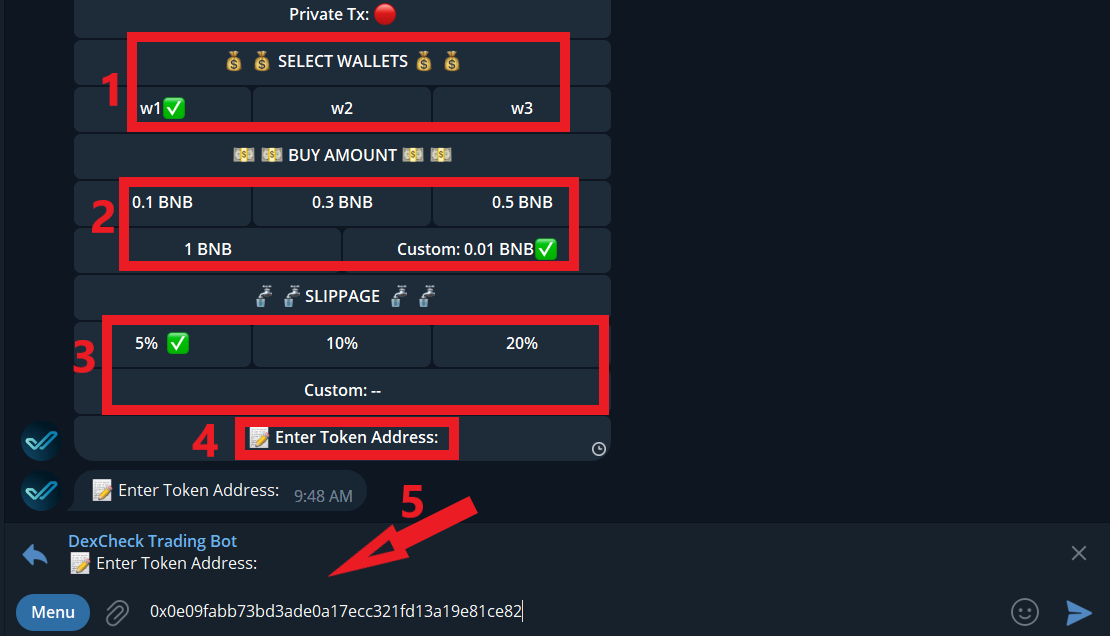
    To make a purchase,

    Click Buy tokens from the menu

    Click on the wallet to select the wallet you are trading from

    Set the amount of BNB you are spending on the trade by selecting any of the options, you can set a custom amount by clicking Custom.

    Set the slippage

    Click Enter Token Address to enter the smart contract address of the token you wish to buy.

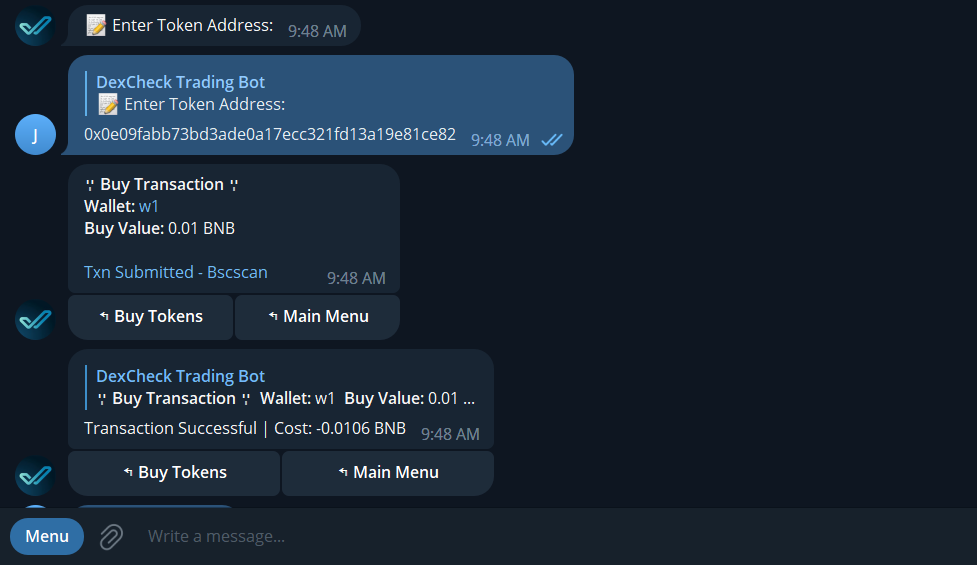
    The Bot proceeds to execute the trade

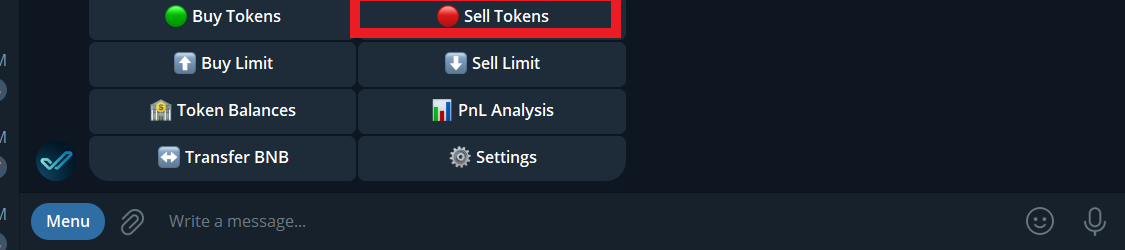
    To Sell a token

    Click Sell Tokens from the Menu

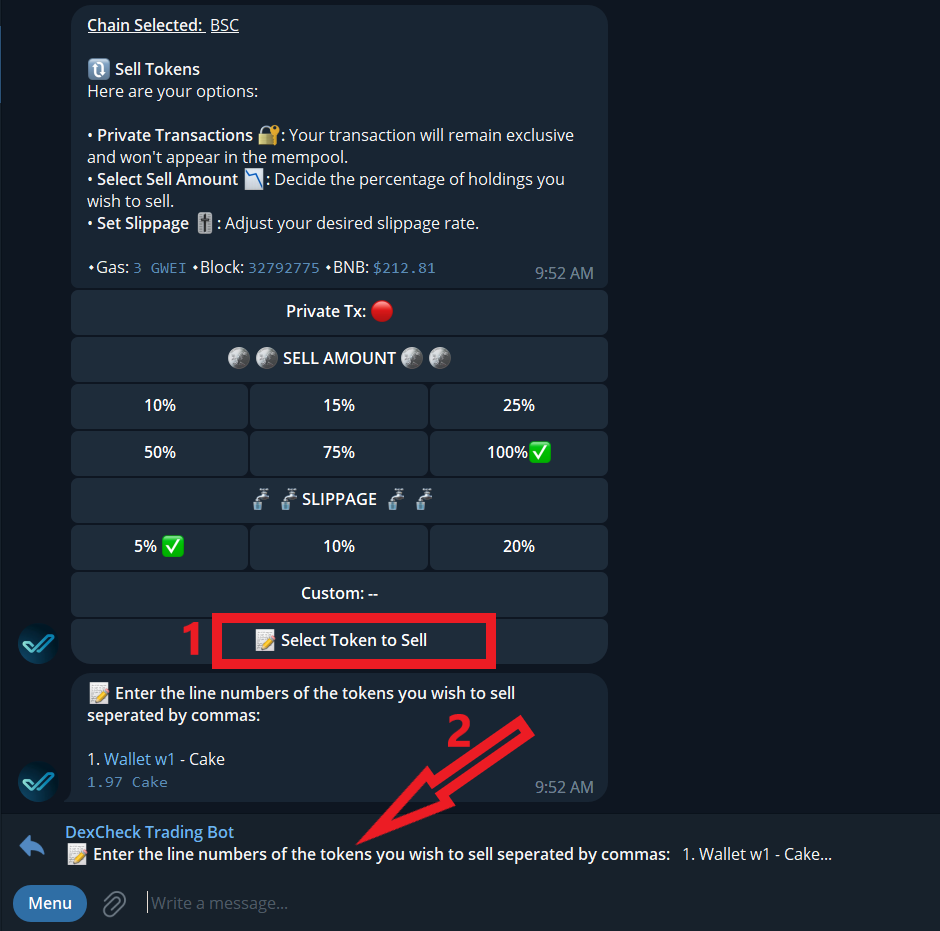
    The bot presents a menu.

    Set the trade details from the menu

    Click select Token to sell.

    The bot presents a list of tokens in your wallet(s).

    Enter the line number of the token you wish to sell and send.

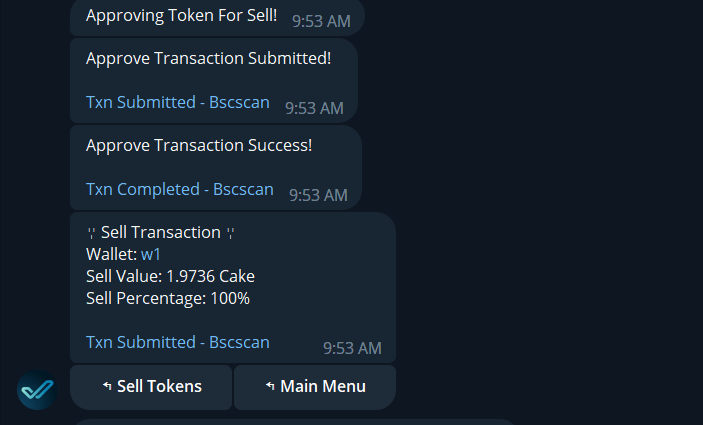
    The bot executes the sell order.

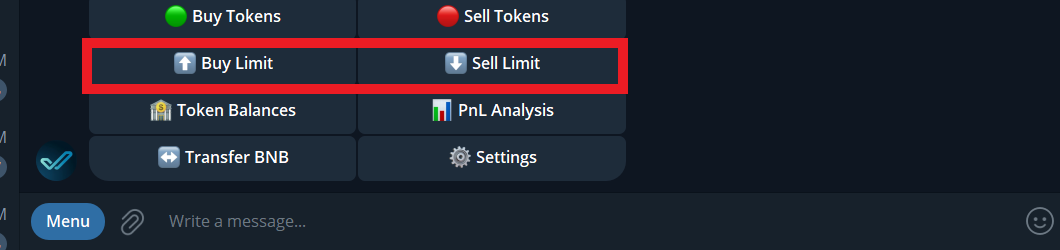
    How to set up limit order trades using DexCheck Telegram bot.

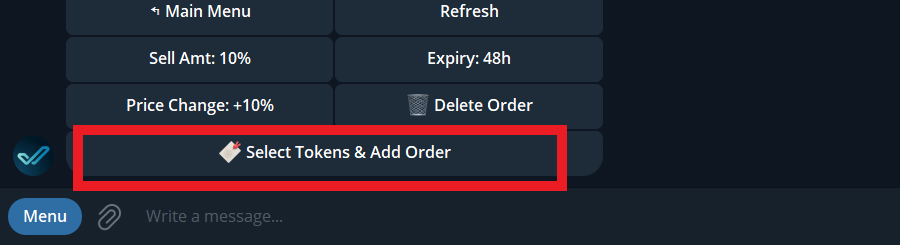
    Click Buy Limit or sell limit from the menu

    Set up the trading conditions including the asset you wish to trade, percentage of your portfolio you wish to trade, the conditions for the trade (percentage increase or decrease) and the lifetime of your order (time for expiration)

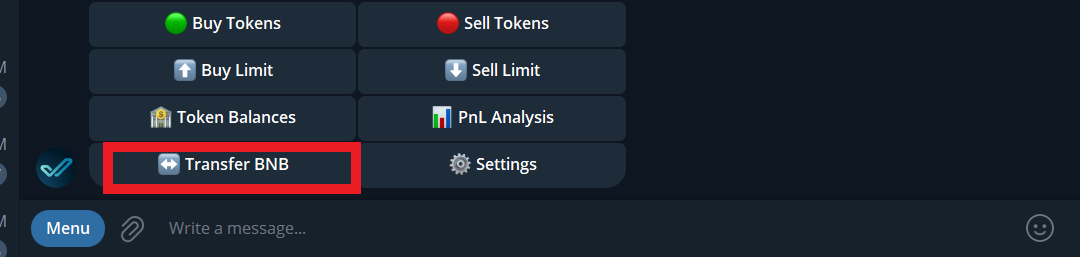
    To transfer assets from your Telgram bot Wallet to other another wallet

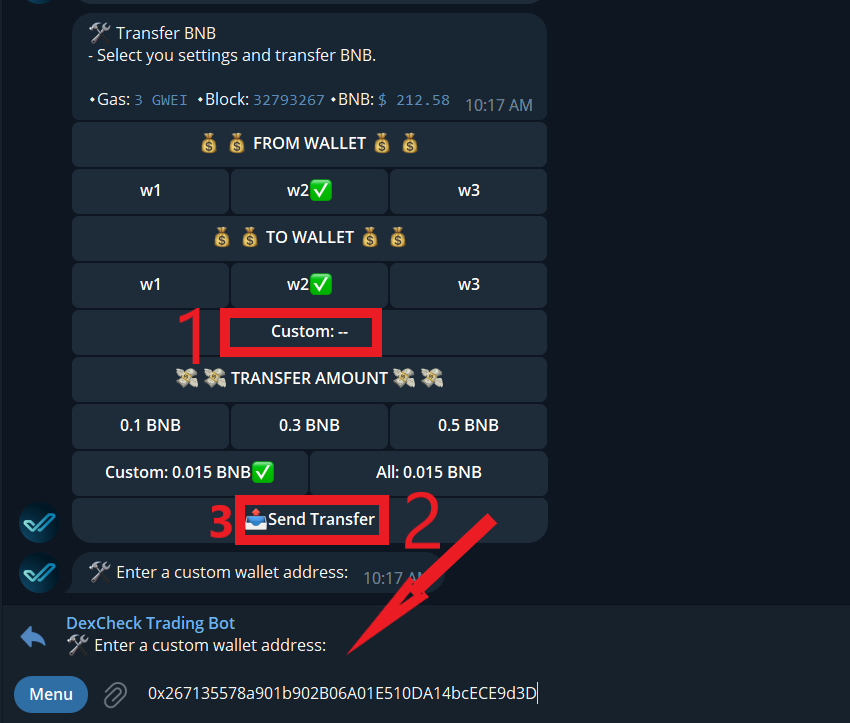
    Click Transfer BNB

    Set the wallet you are sending to.

    If you are sending to an external wallet, Click Customto enter the wallet address

    Set the amount you wish to send

    Click Send Transfer to complete

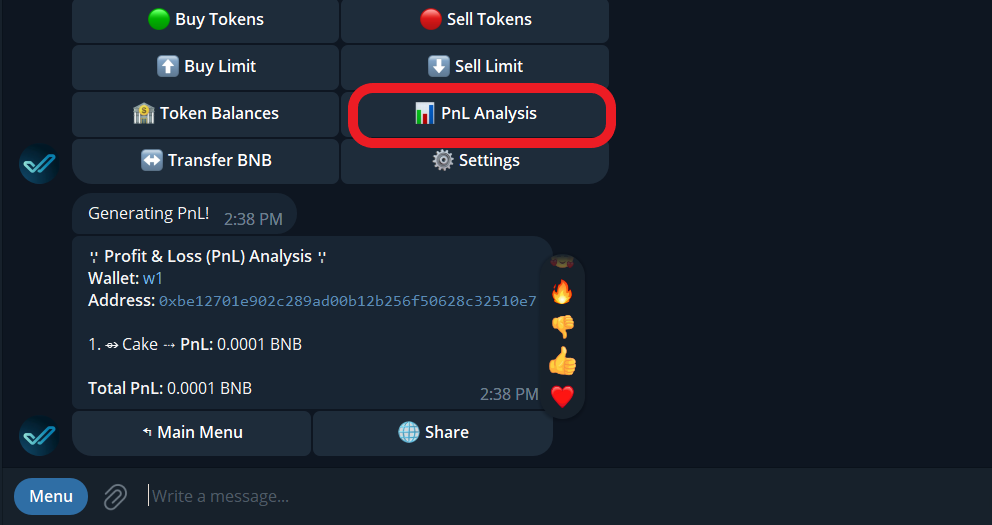
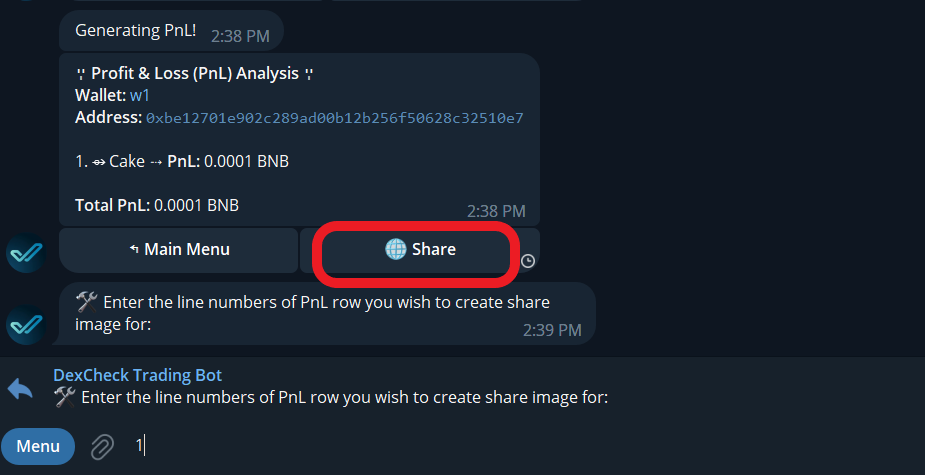
    PnL Analysis

    You can also see a breakdown of your profit and loss using the bot.

    To do this, click PnL Analysis from the main menu

    The bot shows a list of the assets you have traded and the PnL in BNB

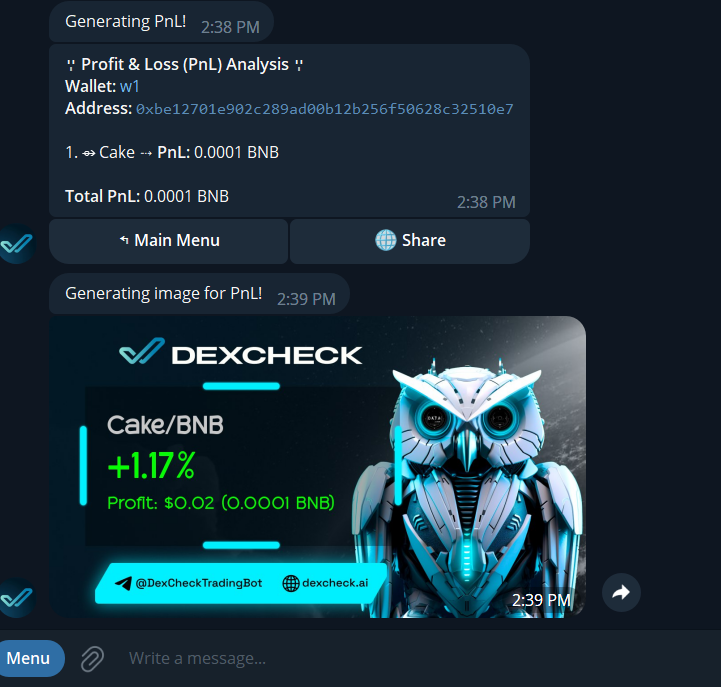
    You can also generate a picture to share with your peers or audience by clicking Share.

    Enter the line number of the asset for which you wish to share a PnL analysis.

    You can now download the image from the bot

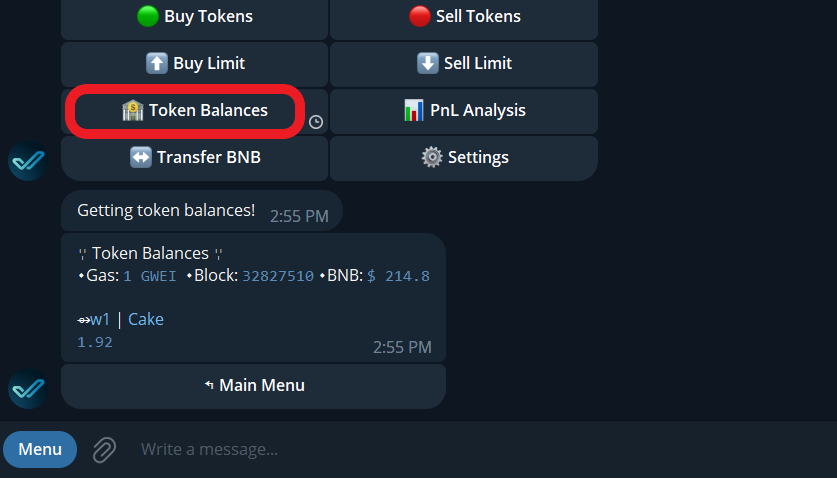
    How to check your token balances

    To see your bot token balances, click Token Balances from the main Menu

    The bot presents a list of tokens held in your wallets

    How to use the DexCheck crypto Wallet tracker bot

    DexCheck Wallet tracker keeps you notified of transactions from a specified wallet. It allows you to set up a desired wallet and screen every transaction from the provided wallet. Wallet tracking is an important part of investment research. As a cryptocurrency investor, track other investors’ wallets and run your trades from information obtained from their operations.

    For instance; if you just discovered a trader with a high success rate on their trades, you can set up the Telegram bot to follow up on their trades and keep you updated on their subsequent moves. You can now copy their trades easily.

    Another use for wallet trackers is to follow up on labeled or suspicious accounts. This comes in handy if you wish to track the movement of a specific asset from the wallet. The DexCheck Telegram bot is able to narrow down your tracking operation to single networks and a specific asset. DexCheck wallet tracker supports 10 networks including Ethereum, BSC, and Arbitrum. It can track up to 20 wallets.

    From the Crypto whale tracker on the Platform, I researched some whales with winning trades on Uniswap (Eth and Arbitrum) and Pancake Swap and I’m tracking their trades using the bot.

    Here’s how to set up the Telegram wallet tracker

    Click https://t.me/DexCheckWalletBot to message the bot

    Click Start to continue.

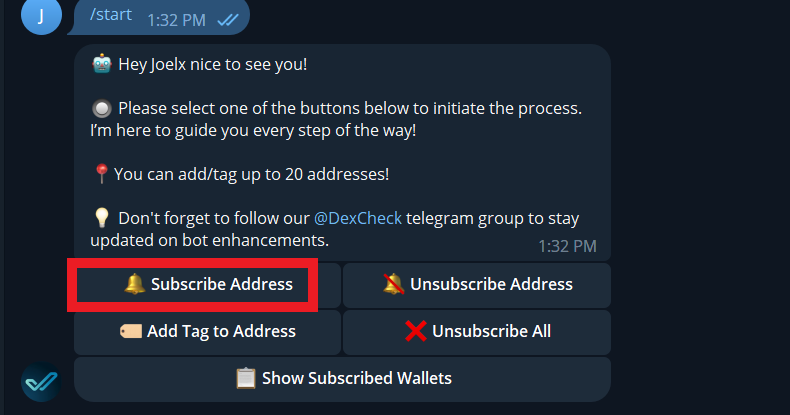
    Click Subscribe Address to add the wallet you wish to track

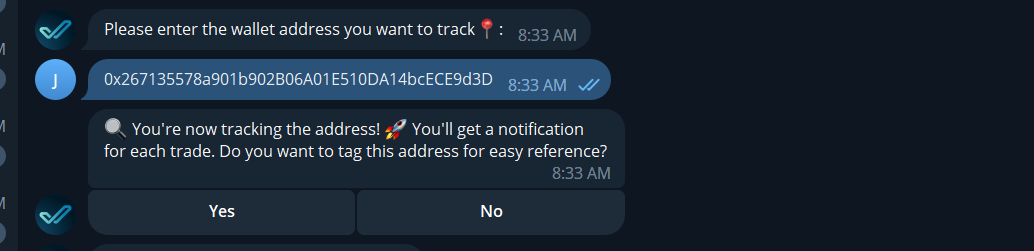
    Enter the wallet address and send to add.

    Now the wallet is added, you can add a tag to the wallet for Identification

    Click Yes, and set a name for the Address.

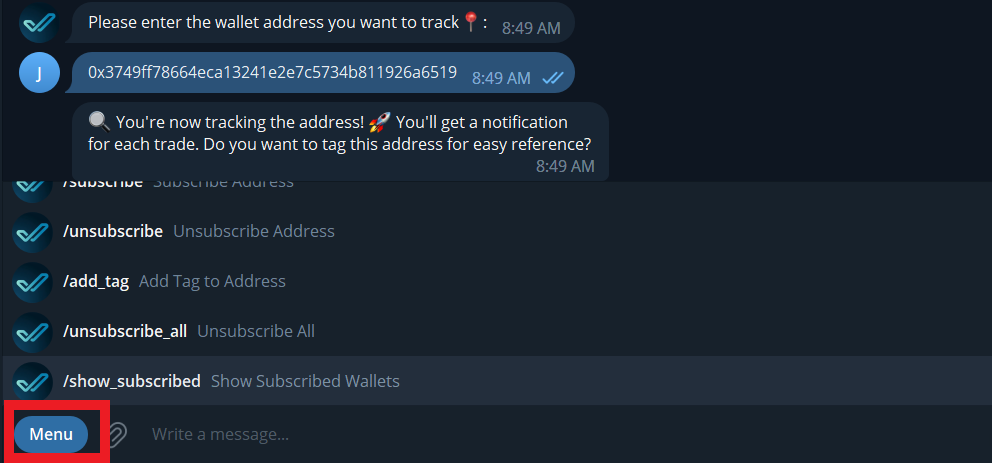
    You can access the bot menu by clicking Menu from the left side of your screen

    To add another address, click Menu and select Subscribe address .

    To tag a wallet, click Menu and select Add tag to address.

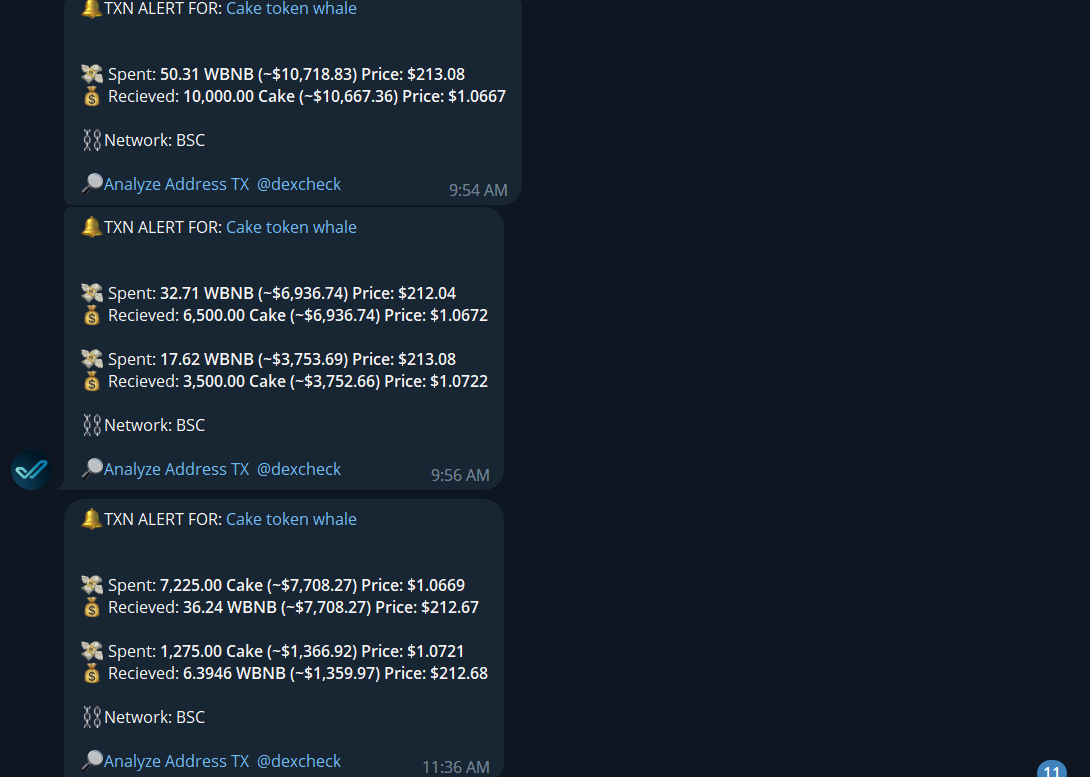
    The setup is done, the bot now tracks trading activities from the wallet across the 20 supported networks. When the wallet executes a trade, you will receive a push notification on your device with details of the trade.

    You can also visit your chat with the bot to see the complete details.

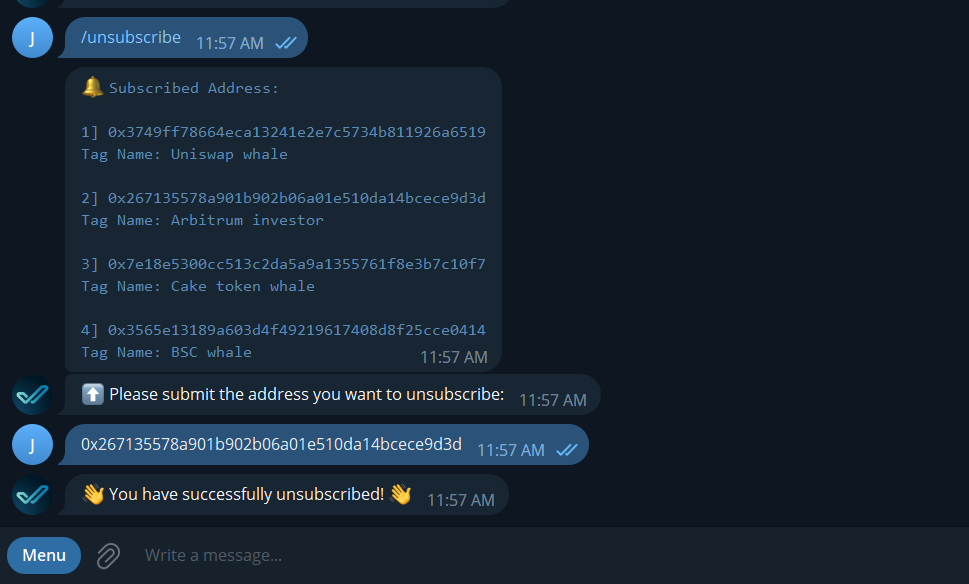
    To stop tracking a wallet, click Menu and select Unsubscribe address .

    Enter the wallet address you wish to stop tracking and send to complete

    How to use the DexCheck SmartFolio bot

    The Smartfolio bot is an optimized asset tracker and management bot developed by DexCheck to help investors keep a check on the assets they are invested in from the comfort of their Telegram messenger. You can import your wallet to the bot or add the assets manually to allow the bot to track them. Here’s how to use the smartfolio bot

    Click https://t.me/thesmartfolio_bot to message the bot.

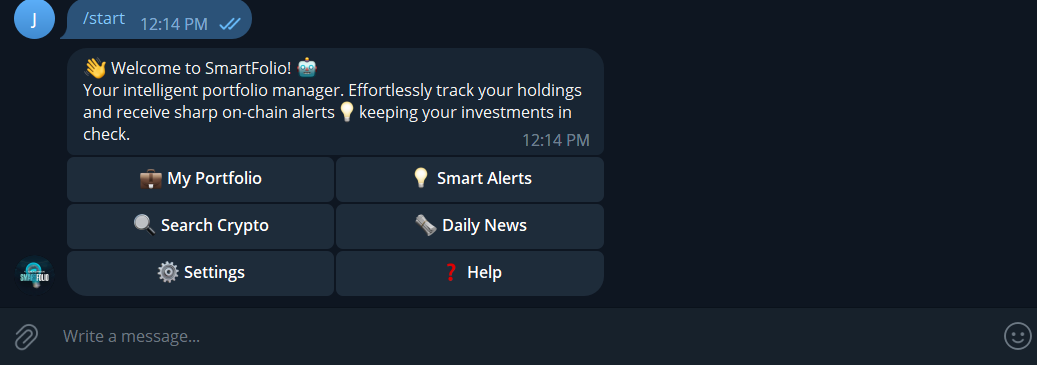
    Click Start to continue

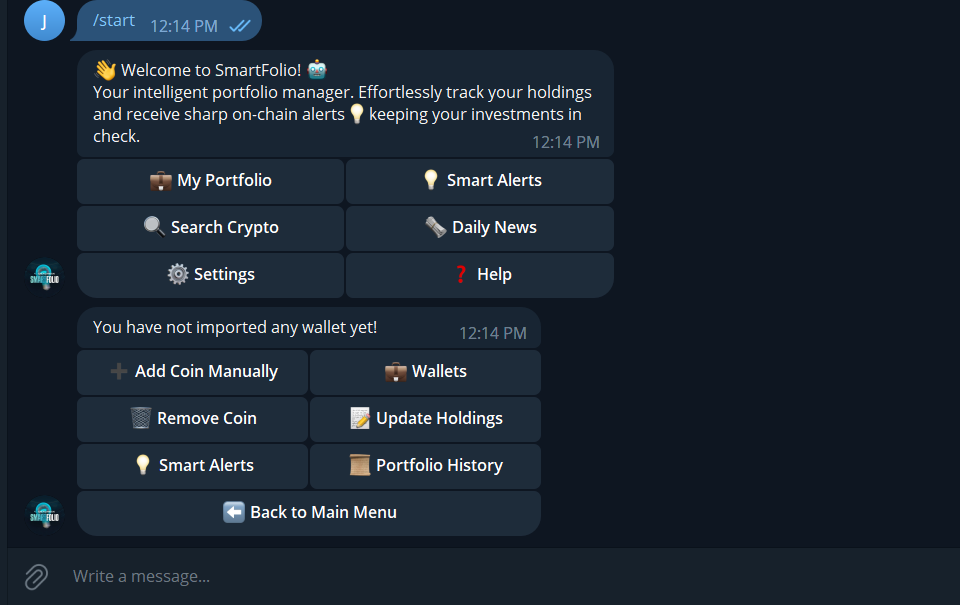
    Click My portfolio to add asset

    This returns a message with an option to import your wallet or track the asset manually

    To track assets manually, click Add Coin manually.

    Enter the Smart contract address or the name of the coin you wish to track

    The Bot presents a list of similar assets, Choose a line number that applies to the asset you wish to track

    Now enter the amount of the asset you own. Send to complete.

    To import your wallet,Click Wallets from the menu.

    Click Import Wallet address to continue

    Enter your wallet address and send

    The bot now tracks the assets in your wallet

    Click My Portfoliofrom the Main menu to see assets

    To set up an alert

    Click Smart Alerts from the main menu

    Click Add new Alert.

    Enter the line number for the alert you wish to set.

    You will receive alerts as it applies to your choice.

    The DexCheck token Scanner Bot

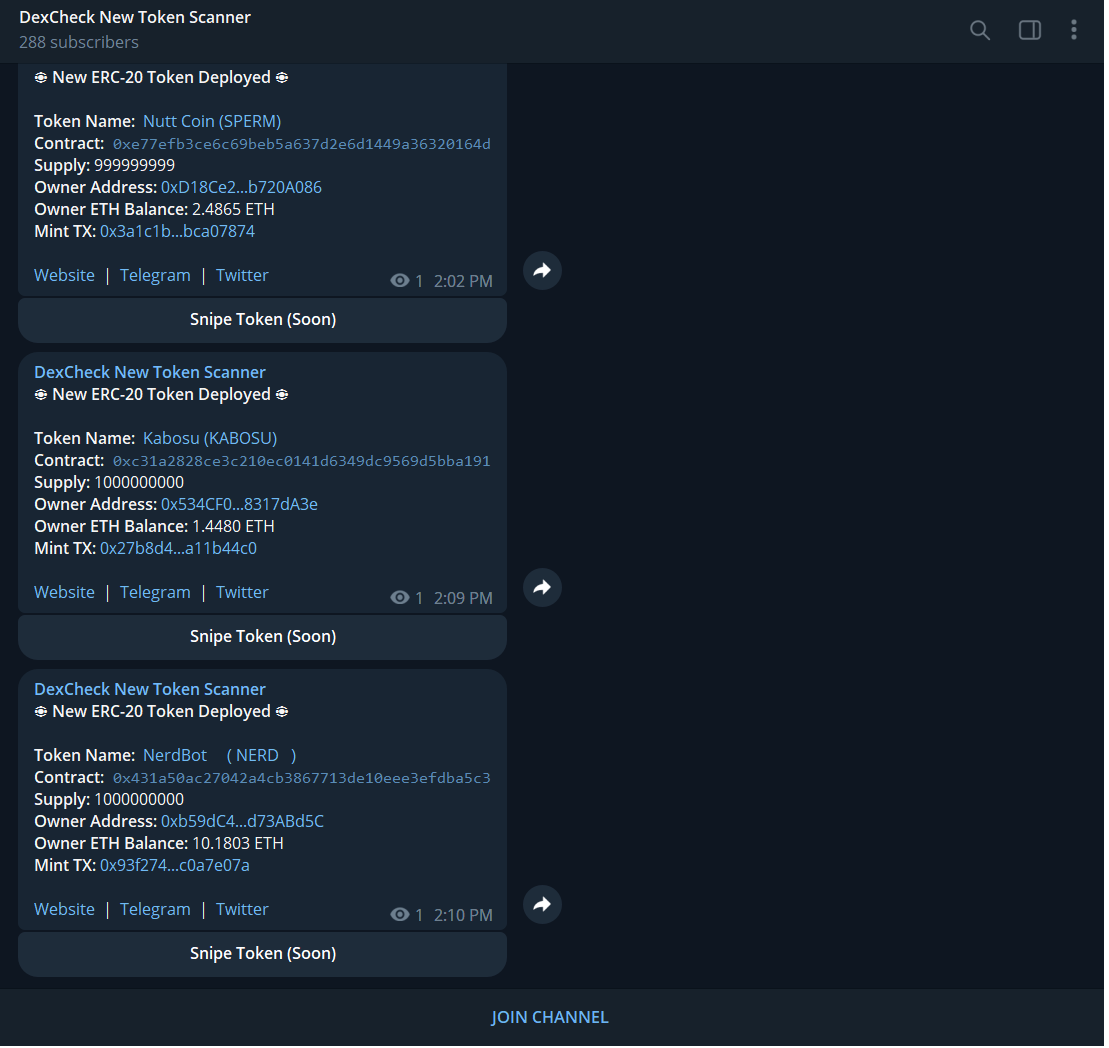
    The Token Scanner bot is the Sniper bot in development. Currently, the bot scans decentralized exchanges for new tokens and alerts users. When the Sniper bot is finally deployed, users will be able to quickly trade (Snipe) these new tokens and make profits by moving before the rest of the market.

    How to use the Scanner Bot

    Click https://t.me/DexCheckScanner to interact with the Bot

    Click Join Channel to continue.

    The Bot now updates you with newly added tokens. When the Sniper bot it deployed, you can quickly trade these new tokens by clicking Snipe token .

    Closing Thoughts

    As financial operations advance, they get even easier. DexCheck’s Telegram Bots make managing cryptocurrency investments as easy as Texting a pal from your messaging application. But this is just out of the numerous advantages it offers. The automation and the ability to run even more advanced operations with minimal effort and maximum accuracy are at the top of the benefits. DexCheck offers vast options in this space.

    For investors whose regular investment procedure involves studying other investors and following their moves, the wallet tracker ensures you don’t miss out on any important move. With vast options to select from, every investor can find a DexCheck Telegram bot that works for them and use it.

    Having said this, it is important to understand how these bots work and how to use them, we have gone through the processes in this article. You can post any questions you may have in the comment section.

    For more information on DexCheck, here are some leads.

    My previous post on DexCheck

    See the latest updates on X

    Available utilities on the DexCheck Platform

    Join the Telegram community

  • Satoshi Nakamoto: Who is he?

    Satoshi Nakamoto: Who is he?

    In the world of cryptocurrencies, one name stands out as both an enigma and a legend: Satoshi Nakamoto. The pseudonymous creator of Bitcoin, Nakamoto’s true identity remains one of the most captivating mysteries of the digital age. In this article, we’ll delve into the story of Satoshi Nakamoto, exploring the origins of Bitcoin and the enduring intrigue surrounding this elusive figure.

    # The Birth of Bitcoin:

    In October 2008, a whitepaper titled “Bitcoin: A Peer-to-Peer Electronic Cash System” appeared on a cryptography mailing list. This whitepaper, authored by Satoshi Nakamoto, outlined a revolutionary concept—a decentralized digital currency that would operate on a peer-to-peer network, free from the control of any central authority. Nakamoto’s vision was to create a system that allowed individuals to send and receive digital payments without relying on intermediaries like banks or payment processors.

    Nakamoto’s invention addressed the double-spending problem that had plagued previous attempts at digital currency. Through a clever use of blockchain technology—a decentralized ledger that records all Bitcoin transactions—Nakamoto ensured that each unit of cryptocurrency could not be duplicated or spent more than once. This innovation paved the way for the creation of a digital currency that was truly scarce and secure.

    *The Mystery Deepens:*

    Shortly after publishing the whitepaper, Nakamoto released the Bitcoin software, and the first-ever block, known as the “genesis block,” was mined in January 2009. From that point, Nakamoto remained actively involved in the development of the Bitcoin software and community, communicating with early adopters through forums and email. However, Nakamoto was always careful to guard their true identity, communicating only through an online persona.

    Despite Nakamoto’s frequent online presence, efforts to unveil their identity were fruitless. The name “Satoshi Nakamoto” was believed to be a pseudonym, and the creator’s true identity remained a closely guarded secret. Some speculated that Nakamoto was an individual, while others believed it could be a group of people working together. The mystery only deepened as Nakamoto’s involvement in the Bitcoin project gradually waned.

    *Legacy of Satoshi Nakamoto:*

    Regardless of Nakamoto’s identity, their creation has had an indelible impact on the world. Bitcoin, often referred to as “digital gold,” has become a global phenomenon, attracting both enthusiasts and critics. Its decentralized nature and limited supply have made it a store of value and a hedge against inflation, while its underlying blockchain technology has inspired countless innovations beyond cryptocurrency.

    Satoshi Nakamoto’s decision to remain anonymous also had a profound effect. It allowed Bitcoin to develop organically, without a central figure to exert control or influence. This decentralized nature aligns with the core principles of cryptocurrency, emphasizing trust in code and the network rather than in individuals or institutions.

    *The Quest to Unmask Satoshi:*

    Over the years, many individuals and journalists have embarked on quests to uncover Nakamoto’s true identity. Some have claimed to have found the real Satoshi, but these claims have often been met with skepticism and debunked. In one instance, Newsweek published an article in 2014, identifying a man named Dorian Nakamoto as the creator of Bitcoin. However, Dorian Nakamoto denied any involvement, and the story raised more questions than answers.

    As of my knowledge cutoff date in September 2021, Satoshi Nakamoto’s identity remains a mystery. Despite the tireless efforts of researchers and journalists, the true identity of the Bitcoin creator has eluded discovery.

    *Conclusion:*

    Satoshi Nakamoto’s creation of Bitcoin represents a watershed moment in the history of finance and technology. Whether an individual or a group, Nakamoto’s brilliant vision has reshaped the way we think about money, trust, and the power of decentralized networks. The mystery surrounding Nakamoto’s identity only adds to the intrigue and mystique of Bitcoin, ensuring that the enigmatic creator will forever be a central figure in the world of cryptocurrencies. While the identity of Satoshi Nakamoto remains concealed, the legacy of their invention continues to evolve and inspire innovation in the digital age.

  • NFT arbitrage: How will it work?

    NFT arbitrage: How will it work?

    NFT arbitrage

    NFTs are one of the seven wonders of crypto, the list will surely change and get even longer in the future, but NFTs have had a hell of a time in the space. From a high-tech concept with huge potential to a meme-like multimedia idea and again to an entity of high financial significance. NFTs reportedly moved over $24 billion in cumulative volume in 2021. This figure has since due to the raging bear market and a lowering interest in NFTs, but NFTs are still very significant.

    A handful of arbitrage protocols have seen huge success in trading cryptocurrencies across centralized and decentralized exchanges. However, these projects are only focused on fungible tokens which make up a majority of cryptocurrency investors’ portfolios. But NFTs are fast becoming popular and coveted assets.

    Proposed theories for an NFT arbitrage system will certainly involve the synergy of protocols that surf through NFT marketplaces to garner data on the trading conditions of recognized NFTs from different collections and compare these data to evaluate the difference in floor prices collections and selling prices on individual NFTs across selected market places and trade accordingly to take full advantage of the deviations to return maximum profits for each successful trade.

    Noted challenges to the NFT arbitrage scheme are the illiquidity of NFTs and loss of profits to MEV (Miner Extractable Value). NFTs are illiquid in the sense that they are first listed and stay waiting for an eventual buyer, NFTs could spend hours to days on the marketplace before a buyer comes around.

    MEV is an issue that plagues cryptocurrency as a whole. Additional charges on every transaction build up into tangible expenses, enough to get rid of every profit made in trades, especially for routine traders on decentralized exchanges. Thanks to MEV, an NFT arbitrage system could see a good percentage of its profits eaten away by extra charges or even fall back into losses even after successfully arbitraging an NFT.

    NFT arbitrage protocols could tackle this using a pool. By creating a pool for NFTs. This pool will present an instant demand for the NFT and ensures that they can be sold immediately. Only NFTs demanded in the pool will be considered for arbitrage opportunities.

    The arbitrage system will basically compare prevailing prices for NFTs in its pool and the price of the same NFTs on other marketplaces. The arbitrage system will proceed to purchase NFTs where they trade for cheaper prices and trade it on the on-demand pool, making a profit. This is recurring and continues until the trades are no more profitable.

    Note that there are currently no known NFT arbitrage projects and this content is only a theory of how a system like this could work. Taking into consideration, the basics of NFTs and available technologies, this might be a ground-breaker for NFT investors.

    Follow up with CRYPTOCURRENCY SCRIPTS to stay refreshed in the crypto space with comprehensive articles and important tips.

    Hire a freelance writer