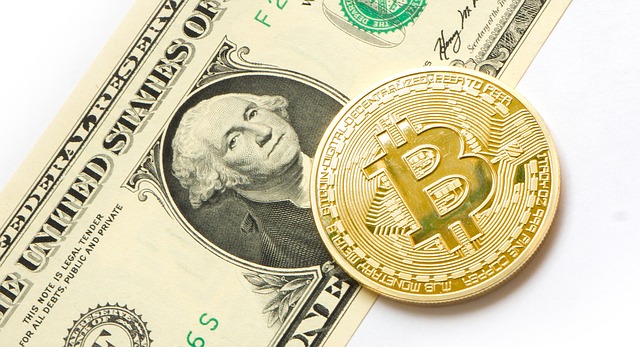
A follower once referred to Bitcoin cash as bitcoin’s ‘Dumb’ brother. That sounds funny anyways, but it’s a perfect representation of the friction between bitcoin and bitcoin cash communities. One cut out from the other, these two don’t really share a very ‘lovey’ history. According to many, “Roger Ver was a bitcoin legend until he decided to fork it”. This article itself could get some stern backlashes and it is easy to understand why.
Bitcoin maximalists are hardly (rarely) impressed with anything outside Satoshi’s brainchild, but the spite for bitcoin cash is on another level. Pretty weird stuff considering the fact that bitcoin and bitcoin cash could serve two different purposes…competently.
As a newbie in the crypto space and before you grasped the concept of blockchain technology, you probably already regard bitcoin as the ‘digital gold’. Making cryptocurrencies tradable and integrating them on exchange platforms similar to that of digitized gold sparked off the long-lasting comparison between gold, bitcoin, and cryptocurrencies at large. Bitcoin is at the helm of this comparison.
Bitcoin’s initial purpose was a flexible payment technology; its current orientation designates it as a store of value… principally. The perpetual comparison with gold, firms adding bitcoin to their reserves, values reaching thousands of dollars; bitcoin is simply a better replacement for gold… even the transaction speed suggests.
Bitcoin Blockchain is adapted to perform about seven transactions per second. Working at this speed, transactions could take over ten minutes to be executed and verified on the blockchain. With the Bitcoin lightning network, you can transact faster. Well, the bitcoin lightning network basically applies clever tweaks to parse your transactions, and via ‘verified trust’ transactions are confirmed ‘offline’.
Borne out of an infamous turmoil and living through a series of ‘dramas; bitcoin cash, a more flexible fork of the original bitcoin presents a more sustainable payment solution. Built for merchants; the ‘cash’ suffix says everything you need to know about it. Albeit criticism from bitcoin maxis, bitcoin cash is ultimately faster than the original bitcoin and works better for the purpose bitcoin was initially created.
Say “bitcoin for investors; bitcoin cash for merchants”. Bitcoin should rather spar with gold and lustrous metals, but adopting bitcoin (in its purest form) for day-to-day financial activities is simply not sustainable. Bitcoin is not scalable and flaunts a rather archaic technology. Bitcoin cash is more developed in these areas and more adapted to suit merchants.
If any ‘bitcoin’ must be used in commerce, it should be cash. You’d have to wait for minutes before the barista confirms your payment and serves you coffee. Relative to most other cases, this is actually a manageable scenario. Bitcoin causes this, bitcoin cash fixes it. Well; the lightning network does too, you’d argue.
Love bitcoin? Buy bitcoin cash as well. Or at least, acknowledge its technological advantages. In Contrast to the current situation, bitcoin and bitcoin cash complement each other and should grow along. Instead, we are witnessing a case where one is pushed to serve both purposes.
Don’t get it wrong; any store of value can serve as a medium of exchange, including gold. But bitcoin cash actually fits better into the idea of a ‘cash’. A number of other blockchain solutions boast faster and more flexible transaction speed; however, bitcoin cash is built on the original bitcoin framework.
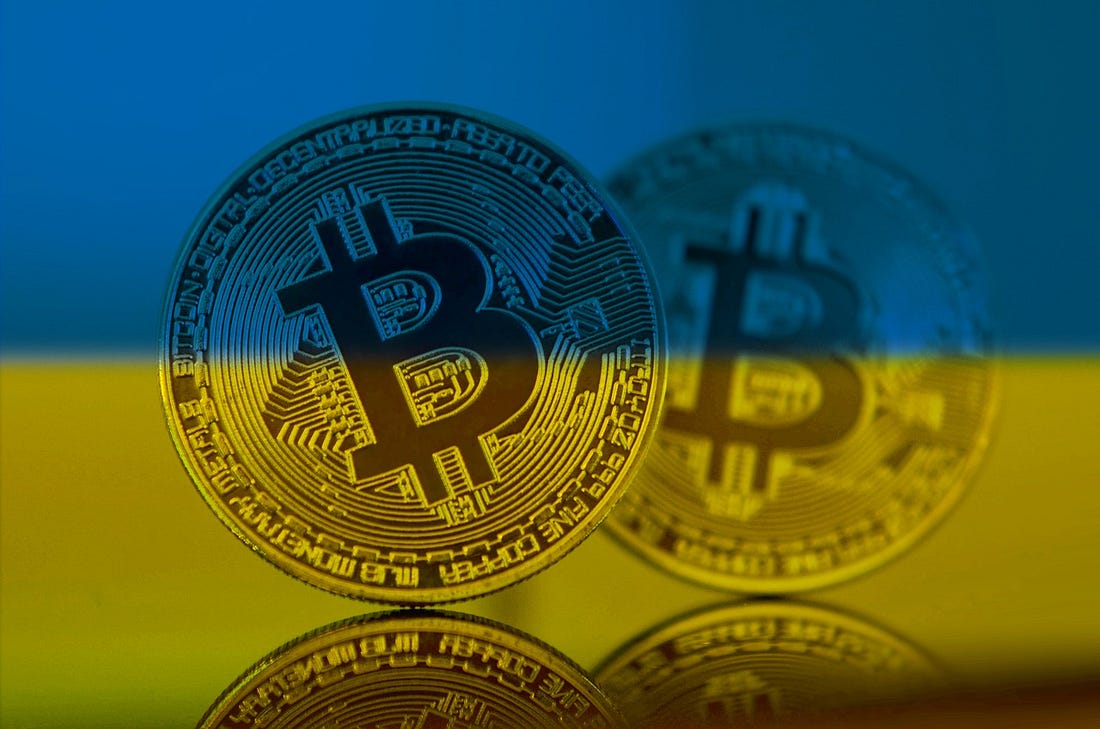
Ukrainians face an uphill battle to retain their country as the conflict with Putin-led Russia continues. Peace talks between the Waring nations haven’t really yielded tangible results; the Russian military is showing no signs of backing off while Ukrainians are keen to fight off their invaders. The harsh effects of the sanctions on Russia’s economy and citizens haven’t been enough to convince her leader to call off the attempts. Russia’s invasion has grounded the central European country’s economy and has displaced millions of its citizens.
While the rest of the world continues to condemn Russia’s actions and assist Ukraine, the conflict could linger on for a while. Support for Ukraine comes from all parts of the world in different forms. As usual, cryptocurrency communities are getting involved. Drumming their support for the eastern Europe nation, over $100 million in cryptocurrencies have since been donated to Ukraine to assist them in their plight.
Being handed millions of dollars in cryptocurrencies via donations, Ukraine nets more than just one advantage. In addition to the financial reinforcement this could bring, cryptocurrencies offer a more efficient financial system relative to the traditional system. For a government thrown into war, an ‘unblockable’ means to exchange value comes in handy. Cryptocurrencies’ underlying technology makes for the most flexible exchange. Devoid of third parties and powering universally acceptable stores of value, it is actually meant for turbulence.
Seeing the role cryptocurrencies have played in his struggle, the Ukrainian president moved to make bitcoin a legal tender in the region. This a reasonable thing to do when you have a tangible amount of cryptocurrency in your custody. We currently have no clue how exactly Ukraine is using the cryptocurrencies donated to them, but at least we can guess. The move to legalize bitcoin hints at positive results from using cryptocurrencies; especially at a time like this. And if more nations will consider adopting positive policies for bitcoin and other cryptocurrencies is a question of if they are actually watching the role cryptocurrencies are playing currently.
In conflict, Ukraine is demonstrating just how useful cryptocurrencies could be in turbulent times. A point of consideration for other nations. It is already playing an important role in digital assets. And even after the war, Ukraine is poised to be a catalyst for digital assets in Europe and the rest of the world…obviously.
The nation of Ukraine is currently in ruins. Thanks to shellings from Russia’s artillery, important structures in Ukrainian cities are in rumbles. Once the conflict ends, Ukraine will be looking to rebuild its nation again. That stash from donations will once again play a role. And as long the nation stays, open to cryptocurrency donations, the benevolent cryptocurrency community will continue to support their recovery. As a legal tender, donations in bitcoin and other cryptocurrencies will be circulated through the nation’s government. Probably as payment to the different bodies assisting in development plans.
With bitcoin etched in the legal books of a country whose development has been badly affected by war, the need to adopt futuristic solutions to fast-track its recovery and competitive ability is a matter of importance. An optimized medium of payment and a superior store of value are good options, bitcoin fits perfectly into this. Just like El Salvador, Ukraine could be the next country to utilize digital assets for national growth.
Unlike Salvadorians, Ukrainians have learned the benefits of using swift payment solutions like cryptocurrencies in a rather unfortunate way. The banking experience during this conflict period is already enough to make them appreciate the distinctions between bitcoin and other cryptocurrencies over their custodial financial systems. Many already hold a majority of their funds in cryptocurrencies, this will continue even after the war.
Ukraine will double as a case study for cryptocurrencies’ relevance in turbulence and recovery. As a nationally accepted medium of exchange, it will play a role in the normal lives of people living in this region. As the rest of the world watches; every event in Ukraine as it concerns cryptocurrencies is a major demonstration of utility. For a concept met with so many restrictions, cryptocurrency and blockchain are proving the rest of the world wrong. Playing vital roles in contrasting times is proof of versatility.
If you live in the crypto space for a day, the acronym ‘DeFi’ comes your way almost twice per hour. No doubt, my statistics are right…or very close to it. The crypto space is a very dynamic environment and everything moves so fast, but you must be living under a rock if you’ve only got to hear about DeFi a few times. You’re unlikely to discover this article if you live under a rock anyways. So, the most probable case is that you’re yet to fully grasp the concept of DeFi.
Swaps, farms, pools, and ‘connect wallet’ lol. Like a ‘plug and play’ system, connecting your wallet to a website is all you need to experience a whole world of fun …and risk. Yeah, accidents on DeFi platforms could get very popular and your first encounter might be through an exploitation report. But DeFi is way more positive than this.
DeFi is an acronym for Decentralized Finance. Decentralized financial systems comprise applications built on top of blockchains that facilitate ‘permissionless’ financial services and provide seamless options for running financial activities. DeFi hopes to introduce the core virtues of blockchain technology to the financial system. Bitcoin introduced the concept of ‘decentralized means of payment’ which runs on a distributed ledger system, the blockchain.
DeFi is a blockchain notion. It encompasses every attempt by blockchain and cryptocurrency projects to create a decentralized replacement or alternative to real-life financial activities.
From Bitcoin blockchain itself and its lightning network to decentralized exchanges and financial institutions built on the blockchain; blockchain technology has dived deep into the economic sector and is making attempts to create a new and better way of handling financial activities.
Contemporary and emerging DeFi projects are, expanding the scope of decentralized financial systems. They are shifting the paradigm from ‘portable means’ of payments to smart contract applications running independently on a parent blockchain and offering advanced financial services such as insurance, lending, wealth management, and an array of other financial management using blockchain resources and exhibiting desired blockchain features such immutability, security, privacy, speed and interoperability.
Smart contract blockchains are hence home to DeFi projects, Ethereum particularly is housing the majority of DeFi projects. Augur, one of the earliest smart contract projects on the Ethereum blockchain and a popular DeFi project offers a decentralized alternative to advanced financial instruments such as index trackers and futures. Aave (LEND) runs on Ethereum Blockchain and provides decentralized lending and borrowing service. Binance Smart Chain (BSC) and TRON blockchain smart contract layers also facilitate DeFi and provide resources that allow DeFi projects to thrive.
Amongst the numerous enticing features of decentralized finance projects, ‘liquidity farming’ has gained its place as the most exciting exercise in decentralized financial systems. The idea of leveraging DeFi protocols to generate annualized interest returns of up to 30% of your initial investment and a couple of other benefits will surely impress any investor. Due to this, DeFi presents enticing opportunities for cryptocurrency investors to dive into the crypto space — a major cause of the recent boom in DeFi projects.
DeFi has benefited highly from incentivization. Flexible staking opportunities, high-interest loans on lending platforms, and high APR liquidity farm rewards…you might want to give up your agriculture career and join crypto. Well, you can do both.
DeFi isn’t without some shortcomings anyways. DeFi space marks a huge resemblance to early crypto space. The emergence of new projects which are mostly a copy of already existing projects with just very little differences; bogus promises, pump and dumps, naive and gullible investors, shady project teams, and ‘get rich quick’ schemes. It has become a hotspot for ‘decentralized accidents’.
Nevertheless, it is still a brilliant invention and is developed to fix these major issues. Mainstream firms are also impressed by the potential of decentralized financial systems.
Just like most other hyped blockchain concepts, DeFi has become a goldmine for many believers. Unfortunately, a tangible more has a relatively different story to tell; but that’s a topic for another day. Diving in early into deFi and exploring the vast opportunities it offers has earned this class of people, life-changing opportunities. Luckily, it is benevolent enough to benefit even newer participants as well.
DeFi is powered by lots of brilliant algorithms, protocols, and project teams, but as usual; it is the ‘money-minting’ potential that attracts most participants. A Normal phenomenon in this space. Well, I wouldn’t blame an investor for levitating towards a platform that promises a 10x annual return on investment, hassle-free. Not just the rewards, the projects’ tokens go parabolic too.
It takes a special conviction to ignore the high APRs on DeFi staking pools and liquidity farms. Like the early days of cryptocurrency mining scams, these rewards seem too good to be true. Actually, they are true; at least they work as stated. But these DeFi incentives aren’t really ‘free money’
Most airdrops aren’t even free money in the right sense. Airdrops are known for the ‘free money’ tag and have maintained this reputation over the years. But the tasks associated with certain airdrops are in fact more worthwhile than the airdrop rewards. Staking and liquidity farming is, however, different in many ways.
One is a tokenomics and marketing strategy; the other is a proper reward for a (vital) service; staking and liquidity farming have become the most accessible and arguably lucrative DeFi opportunities.
Staking is a low-risk reward program that incentivizes token holders for locking their assets in the staking pool. Staking rewards are flexible and Annual rewards may vary depending on the platform and circumstances. Most DeFi staking programs are flexible too and stakers can unstake their assets from the pool at any point in time. Others might require locking your assets for a specified time during which these assets cannot be unlocked or can be unlocked with penalties. The DeFi staking process is simplified and is a popular choice for micro and medium investors. Most investors prefer staking over liquidity farming for some reasons…
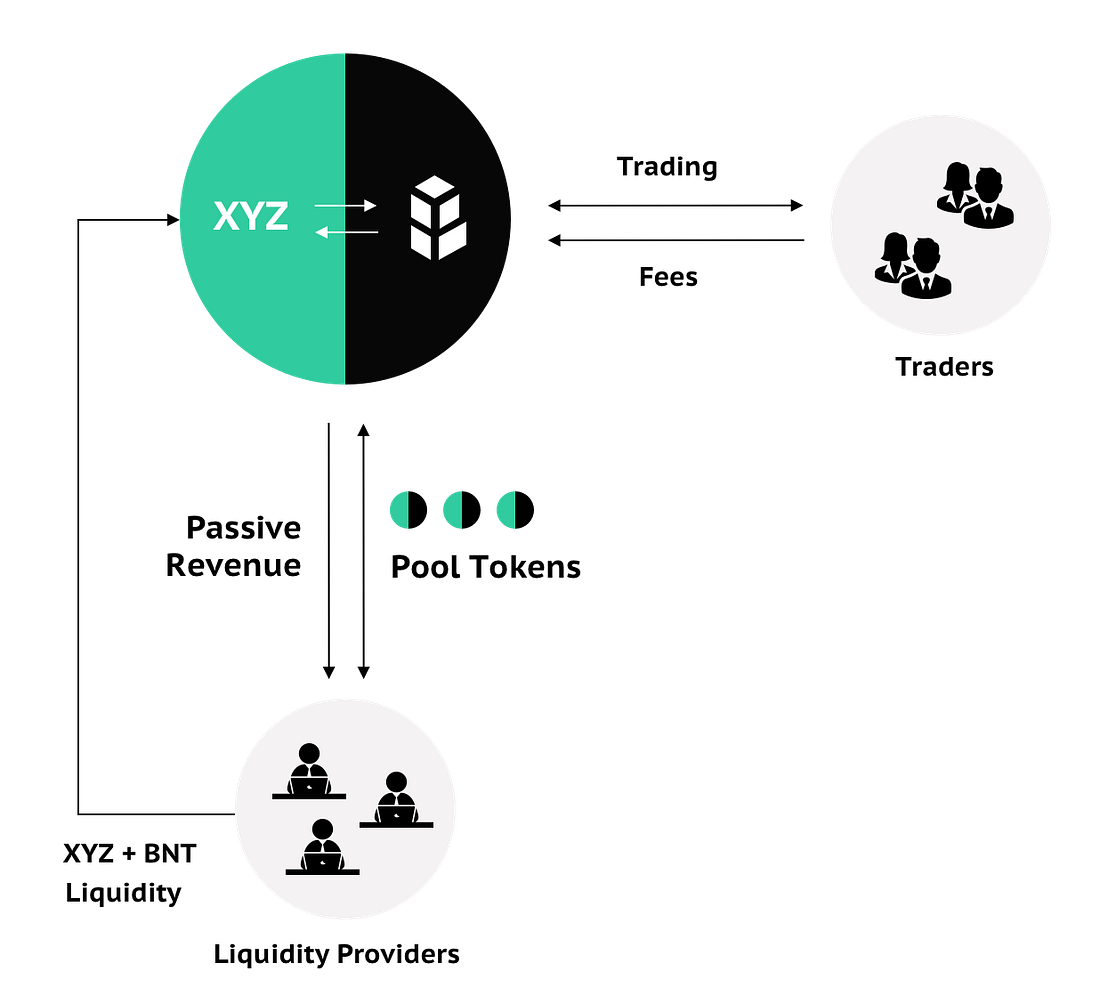
Liquidity farming on the other hand provides investors an opportunity to earn more tokens by locking their assets in the liquidity pool. Assets locked in the pool enable seamless swapping of the locked tokens. A liquidity provider locks an equal value of a pair of tokens/coins. Other holders can swap any of the pairs in a simplified swap transaction. This is powered by Automated Market Makers.
Liquidity providers are in fact one of the most important parties in decentralized exchanges. The role they play is irreplaceable. The reward for this role is the liquidity provider fees. Some projects go ahead to set up an extra incentivization scheme — Liquidity farming. Liquidity farm APRs are usually higher than single-side staking.
‘Free money’ might have different definitions by different people, but amongst these two, Single-side staking would fit into most of the definitions. Liquidity farm rewards are more of compensation for a very important service. Liquidity providers risk losing a tangible percentage of their investments to impermanent rewards depending on the volatility of the market and the assets they supplied to the liquidity pool.
Want some free money? Well, you are better off staking your assets in a suitable single-side staking pool. Sometimes, liquidity farm rewards aren’t enough to pay for the impermanent losses incurred by variations in asset value. In contrast, staking rewards are closer to being ‘free’.
No pun intended; I’m not poking fun at the popular COVID-19 prevention slogan. But if that’s what will make you refrain from centralized exchanges for a while, then I’ll happily do so. My frequency of using centralized exchanges has decreased over twice times the initial. If we can get rid of fake volumes, centralized exchanges are probably rubbing shoulders with decentralized exchanges; in terms of volume, user base, and application.
Despite years of efforts and modifications, fake volumes have continued to bite down on the reputation of centralized exchanges. Aided by exchange officials or solitarily, cryptocurrency projects could easily fake buy and sell orders to lure investors who are attracted by high volumes as proof of demand and liquidity. This could happen anywhere though, but it is more prevalent in centralized exchanges. Centralized exchanges and their technology have served for the time they dominated the space. No doubt, they flourished due to the incredibly handy services they offered. In essence, these services were the best available.
Hacking centralized exchanges is unarguably the most profitable for cryptocurrency scammers. The incidence of exchange hacks lead to the loss of huge amounts of funds. Mt. Gox, Bitfinex, Binance, Kucoin…the list is actually inexhaustive. Getting access to hot wallets of custodial exchanges is a jackpot for hackers who are in a constant attempt to break their way through.
Funds on centralized exchanges are in fact not owned by the ‘owners’. ‘Not your keys, not your coins’. Regardless of how ‘SAFU’ the exchange promises you about the safety of your assets, your cold wallet which you (and only you) hold its private key is the safest place to store your cryptocurrencies. Blockchain technology assures fund security, but this is only when they are truly in your custody, and this is as long as you’re the (only) one with the knowledge of your wallet’s passcodes and private keys.
So, here’s a simple fix; decentralized exchanges…
Unlike the rampant centralized exchanges, decentralized exchanges do not have buy walls and sell walls, yet the exchange of assets is unrestricted. Even a cryptocurrency veteran would wonder how this works exactly. Well, decentralized exchanges are powered by a number of protocols that allow users to swap assets seamlessly without third-party holding custody of their assets before, during, and after the swap.
Decentralized exchanges are powered by Automated Market Maker (AMM) protocols which leverage liquidity pools to ensure a seamless exchange of assets while retaining blockchain-level security.
Automated Market Markers are programmed to be highly organic and responsive. Like a real-time trading system, every bit of supply and demand creates a relative effect. Traders and investors are handed efficient tools for making decisions and projects are represented for what they truly are…at least for that point in time.
Thanks to liquidity pools, AMMs provide a basket of exchangeable assets to enable unrestricted trading for the period in which the liquidity providers wish to leave their assets on the pool. The transparency of the liquidity pool allows traders to make their decisions.
AMM protocol ensures that every buy and sell effect reflects relatively on the asset price. AMMs are not completely resistant to manipulations, this is evident in the rampant rug pulls. But on the brighter side, these actions are transparent; an important feature of blockchain technology.
Albeit certain shortcomings too; here’s how decentralized exchanges keep you safe(r).
Custody of assets
Decentralized exchanges provide ‘blockchain-level’ security by allowing users to exchange their assets without having to give up their private keys. Private keys give everyone complete control over their individual cold wallets. The security of assets in these wallets is only compromised when the wallet owner gives away their private keys. The recipient of this private key assumes ownership of the concerned wallet and assets therein. In centralized exchanges, asset owners are not in possession of their wallets’ private keys; these keys are rather held by the exchange and are in complete control of the assets in their possession.
In cases of exchange scams, or accidental demise of the holder(s) of this key, assets held in these exchanges are completely lost and there are little or no chances of the holders reclaiming their lost funds. This won’t be the case in a proper decentralized exchange as wallets and asset ownership are not compromised in any way, holders retain private keys to their individual wallets and simply connects to the exchange and enable their assets for trading.
Programmed and time-based permissions
Decentralized exchanges require certain permissions to interact with your wallet sufficiently to allow asset swaps, but these permissions are essentially approved by you and last as long as the particular swap is executed. Once a swap is completed, the permission is retrieved. The protocol will need to make another request before regaining this access to execute another transaction. This ensures that you retain control of your assets at any time you’re not interacting with the platform.
In-wallet assets’ resistance to exchange exploitation
Decentralized exchanges run into hazards too. Countless technical exploitation has been reported on certain decentralized exchanges and defi platforms. This is more rampant with DEXes offering other specialized services powered by novel protocols. Flash loan services have been subjects of exploitation and a large number of assets have been lost in the process. However, this doesn’t affect assets in wallets even if the wallets have interacted with the platform. Fraudulent smart contract codes can avail hackers of a sustained connection to personal wallets, but this is a special case. Assets safely stored on wallets are safe, even if the DEX runs into hazards.
In addition to preserving your identity and allowing you to swap assets from the comfort of your (personal) wallets, decentralized exchanges are evolving to keep your assets as safe as possible while you perform core exchange activities. Stay safe; use a DEX
Rough statistics estimates about twenty new cryptocurrencies are created daily, only a few make it to tracking platforms. On average, half of this figure is listed on tracking platforms every day. The past five years have seen a meteoric growth of cryptocurrency projects, thanks to widespread interest and adoption. Over twenty thousand (20,000) cryptocurrencies are listed on digital assets tracking platforms, most of them coming to life in the past three years.
As the crypto space grows and assets proliferate; investors are always in search of simpler ways to keep track of this growth and manage their investments as well. As a result, asset tracking and management utilities are great tools for digital investors and enthusiasts.
Like crypto itself, platforms offering this service are also getting rampant and investors could easily mention a handful. Regardless, these platforms have not really been able to satisfy most investors’ needs, individually. Investors either resort to using multiple platforms or finding a different walk-through for features not available on their asset management platforms.
A number of asset tracking platforms boast “an ‘all in one’ stop for everything an investor needs”, but in practice, only a few come close to this. In addition, these platforms are marred by other inefficiencies. Making up the list includes; inaccurate data, loading lags, and poor asset representation.
Personally; I always have to switch through a few asset trackers, a tedious process. This experience is the same with most other investors, probably you. If you relate to this (and even if you don’t), you might want to pay attention to the rest of this article.
Meet CoinLore; A complete investor utility platform.
CoinLore is a unified, free-to-use asset tracking and management platform built to meet the need of everyday investors in crypto assets. CoinLore provides untampered data for almost ten thousand (10,000) crypto assets and empowers investors with vital tools for investment research and management. In addition to already existing assets, more reputable digital assets are being added daily on the platform to allow holders to keep up with price developments for their assets.
Built for investors, by investors
Investing in crypto is a special exercise; ‘tricky’ is a proper term. With every new cryptocurrency project comes new proposals, algorithms or technology. One thing in common with these projects is that they present ‘huge’ potential and are the ‘next big thing’…until they are not. The high rate of project proliferation is also followed by a spike in the frequency of project failure. In each case, investors are left to nurse mild to grave losses.
The best way to empower players in a space of this kind is to optimize services provided to suit them; protect them.
Developed and managed by a team of experienced investors; CoinLore is runby a team that understands what it means to be in the crypto space. This is depicted by the platform’s structure and resources presented to users. The white-themed platform easily fits an investor’s cravings.
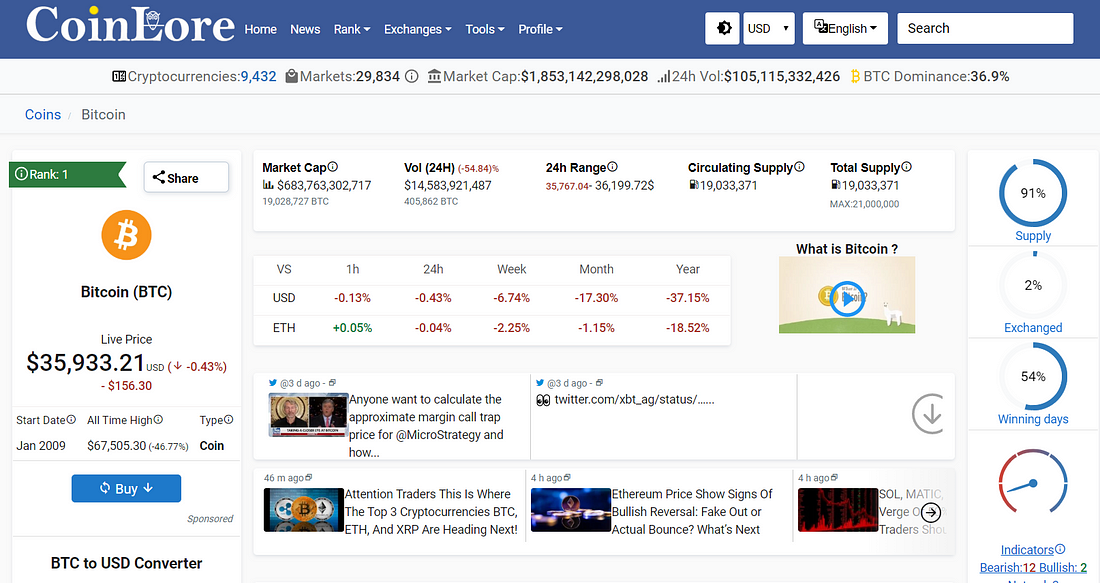
A glance through the platform shows a user-centric design. On a desktop view, the platform’s design is crafted to shine users’ path through investment utilities in a presumed order of importance. Quick navigation options are displayed on the top bar to allow visitors to surf through the platform. Easily log in for existing users or create a new account by clicking ‘Login’ from the menu bar. Platform and total market metrics follow this in a relatively familiar fashion. Following this are other sections of the platform containing asset and market data. In the main section are crypto assets listed in order of their market capitalization. Users can easily modify this section according to the information needed. The parameters shown at the top of CoinLore’s main asset listing section can be used to select a specific class of assets to be shown and the order of appearance. This feature is best suited for users who are interested in separate asset classes such as DeFi, NFTs, smart contract tokens, and coins using a specific consensus algorithm.
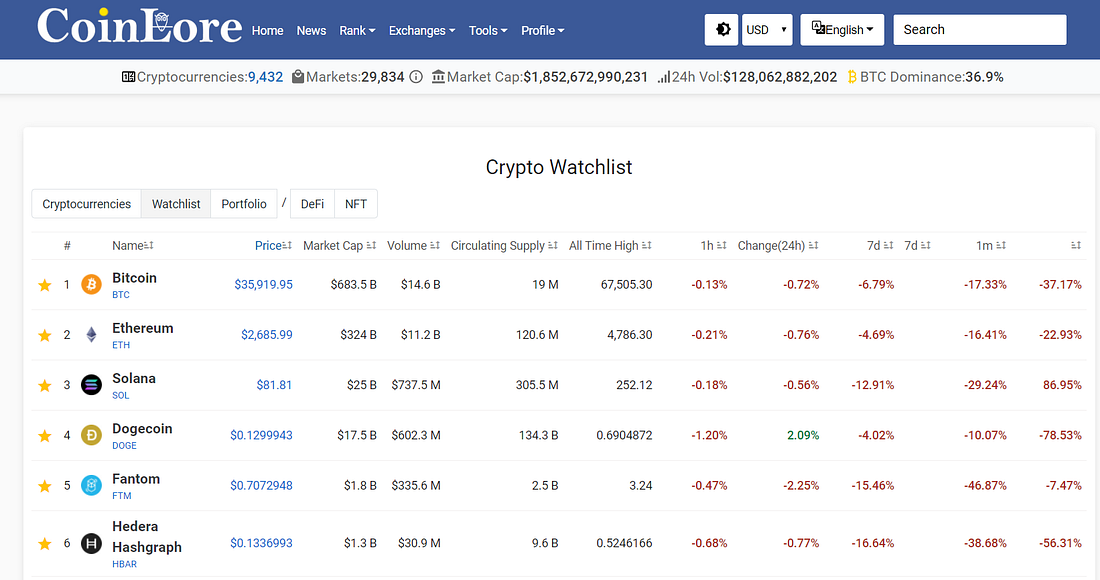
While logged in, you can add coins to your watch list by clicking the star icon on the left side of the asset. Adding assets to the watch list makes it easier for investors to monitor their price developments.
On the right section are classified market data and general information. A market overview section and compartmentalized list of daily top gainers precedes the news feed. The news feed features remarkable happenings in the crypto space, it is a minimized version of CoinLore’s news aggregator. More crypto-related news and resources can be obtained by expanding this section.
The event section follows and features major upcoming developments for projects. This includes exchange listings, DAO voting, token migrations, launches, and other events investors might need to take note of. Spot and margin traders can utilize this for their periodic investments. This section is followed by a video section and other metrics which can be easily accessed by any user.
Track your assets on the go!
Hectic day? We’ve all been there a couple of times. But unlike most other investments, cryptocurrencies have pronounced volatility and a whole lot could happen in just a very short space of time. A few hours might be too long. Being in this space requires a certain level of dedication, especially for day traders. Long-term holders aren’t left out anyways.
Staying informed while you go about your daily activities is easy with the CoinLore mobile application. Just like the desktop platform, the mobile application enables you to track your assets, manage your investments and obtain vital information; but this time, you can do all these from the comfort of your mobile devices. With the mobile application, CoinLore offers a mobile-friendly version of its platform to users who might be unable to use the desktop platform. Your Coinlore account can be used on mobile applications and desktop platforms.
The mobile interface differs tangibly from the web platform; but like the latter, it is simplified and easy to use. Coinlore mobile application is available for Android and Apple devices.
Why CoinLore?
There are a good number of asset-tracking platforms and you surely use at least one of them. This article might be the first time you’ve heard about CoinLore. In a sea of options, what makes CoinLore special and why choose it? If you read through to this point then you already have your answers. But, here are more reasons why you should try out CoinLore today;
Frank asset ranking and detailing.
A major issue on many asset tracking platforms is wrong information as regards prices, distribution, and history. Cryptocurrency investors are fond of making hasty decisions and only a few care to verify claims before going ahead to hold, purchase or sell their assets. Tracking platforms then have a duty; to deliver accurate information as possible for their users. Unfortunately, this is not the case on many platforms, and sometimes last year following a hitch on a popular asset tracking platform; you would have to pay over a trillion dollars for one Ethereum.
The popular price hitch was obviously unbelievable, but a good percentage of investors didn’t understand it this way. CoinLore understands this obligation and embraces it through sincere information on assets and careful practices to avoid running into generalized issues.
Real-time asset valuation
Asset values on CoinLore are flexible and are updated regularly using information generated from exchanges where these assets are traded. Data from the exchanges’ API are collated and average prices are displayed. CoinLore’s technology allows the displayed prices to vary according to activities on the exchanges. Prices displayed on the platform are in fact the assets’ value at that particular time, this could change in the next second.
Handy metrics and information for investors
You’ve seen the news feed and the events section; these are incredible utilities for cryptocurrency investors. CoinLore goes beyond this and adds other features that assist investors in making decisions and also simplify asset management. CoinLore’s asset widget contains detailed information about a selected asset. Events and distribution information can be obtained on the asset page. Blockchain statistics for coins are also available. Traders can also determine their next move using accurate price charts provided on the asset page. Asset performance by sector is also important data for investors wishing to dive into a specific cryptocurrency sector.
These data come in handy for every investor regardless of their involvement in the space. In one stop, your next move can be decided; no, you don’t need to get any information from another platform. CoinLore makes that possible
A user-centric interface
Have you ever stepped into a store where everything is placed just the way you want it? This special feeling is the same when you use CoinLore’s asset tracking platform. The platform’s appearance and flows are designed with a cryptocurrency investor in mind. Every feature on the platform serves a special purpose for at least a level of crypto investment. Looking for a tracking platform where your preferences are highly represented? You have your answer
Responsive and performance-optimized pages
I jumped from Coinlore’s desktop platform to the mobile application and again to the web platform on my mobile device. Different appearances, but one thing that didn’t change is the impressiveness of the user interface and the smooth user flows in each of these platforms. The responsive design ensures that the platform can be used on every device without a dip in the quality of users’ experience. You can manage your assets and plan your next investment move without having to worry about lags and an ‘annoying’ platforms.
CoinLore is impressive, no doubt. A few caveats would be the number of assets listed on the platform; many users would also suggest a more contemporary user interface feature. However, the listing process is open and you can contact the team to get your favorite asset listed on the platform. The listing process is manual as projects go through manual auditing before being added to the platform. Adding some contemporary UI design trends might slow the platform down as well. Regardless, the platform is in constant development and the team is responsive.
NFT enthusiasts have moved Billions of dollars in NFT arts and multimedia since the idea came to life as a valuable item. Mainstream and local artists have since made life-changing wealth from selling otherworldly arts and rare pictures. (successful) NFT traders have turned their fortunes around by flipping NFTs on NFT marketplaces. The widespread rumors of staged trades and artificially bloated NFT might not be a fact, but the mind-blowing NFT value figures could easily trigger rumors like these. Bored Apes are arguably the most popular NFTs and have seen incredible growth; in popularity and value, but many other similar projects have seen wild growth as well.
I’d assume every NFT trade and positive statistics to be 100% real, even if they are not; the concept has been undoubtedly yielding for anyone who dived in successfully. Do share your NFT story with us anyways! That being said, the scope of NFTs has been grossly limited to art trades and multi-media vending. Denis Rodman’s NFT collection has moved over 590 Ethereum at the time of this writing. The popular ‘tough’ guy made it clear that he simply “want to make money” from his NFT drop. Not sure about his current financial condition, I only hope 500Eth is enough money. He probably made more from throwing balls for a few hours.
Expensive arts have a rich history, you might have seen movies about them. Dwayne Johnson and Ryan Reynolds did a good one too. In contrast to NFT, these are (very) special Arts and usually ‘one of ones’. Well, when you simply have to move some nerdy virtual coins, you are bound to be a bit extravagant. The NFT buzz has tuned down a bit, but this can be blamed on the crashing cryptocurrency market. A return might be possible when the market returns, or even before then. Regardless, most NFTs have seen their peak and will always be a shadow of their best, but NFTs will continue to be a prized asset for quite longer.
The future of NFT is however not geared towards a continuation of the photo-vending use case. While artists will still be able to drop their arts on marketplaces for collectors, this practice will begin to fade when NFT arts fail to meet up with the utility demands.
Arts and multimedia trading is the current buzz, but the utility of NFT as technology lies elsewhere. Cryptocurrency projects are already exploring ways of introducing NFTs as a competent way of assigning viewership tickets to sports fans. A welcome development and NFTs will do just well in this aspect. NFT sports tickets are easily verifiable and immutable. Just like NFT vouchers, these tickets can be easily redeemed and reused. Cinemas can also adopt this exact technique to issue movie tickets to their customers. NFT attributes can be used to encode the provisions of these tickets.
NFTs could replace the traditional algorithm of assigning ownership rights to vouchers. Spending NFT vouchers is as easy as redeeming an NFT for a prize. This also saves the institution from producing new vouchers regularly as NFT vouchers can be re-used over and over again…as much as possible.
Novel Cryptocurrency ideas have a record of fading into obscurity after a period of hypes and panic buys. A rather general phenomenon. NFT arts could follow a similar route while real utility NFTs take place in mainstream sectors. Would be a win for the technology itself. In contrast, these will struggle to command the financial sways NFT arts have easily pull-off for the past year. NFT minting platforms and marketplaces could still retain their function though not for billion-dollar daily transaction volumes.
Not to worry anyways; the most used words here are ‘might’ and ‘could’. These new use cases are still a couple of years away from relevance. Even if they come earlier, you’ll still be able to flip your ‘rare’ arts as long as collectors are willing to throw some heavy bucks on your collection. This is, however, for new NFT projects or older ones that stood the test of time. There won’t be many of the latter…of course.
That title sounds a bit like a moonlight tale or a chapter from a kids’ storybook. But that’s fine, it’s a fairytale anyways. A fun one, but not too funny for the other half of the Twitter workforce stripped of their salary source by the beloved DogeFather.
When Billy Markus and Jackson Palmer were editing the bitcoin code to create Dogecoin, they certainly never believed that its destiny will lie in the hands of a nerdy billionaire. It is what it is though, the SlumDoge millionaire must be clearing up his garage for his new Tesla CyberTruck since Dogecoin has returned to the top gainers’ list and might finally land that Twitter deal.
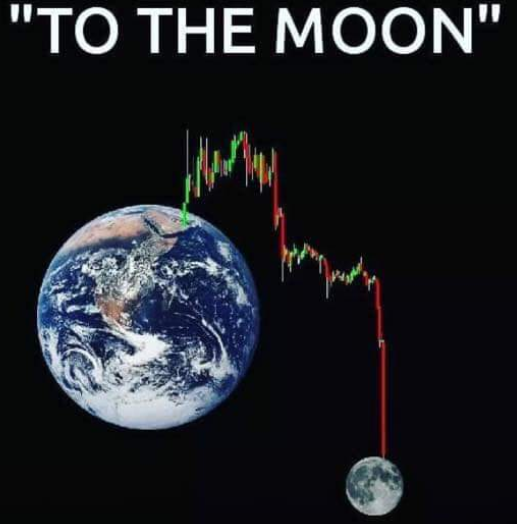
The Twitter-dogecoin Saga is like a toxic rich couple relationship. Frequent fallouts and even stronger comebacks, each one attracting huge financial involvement. When dogecoin hit $0.7, the rocket man was the big propeller. This time around, the story is the same, the only difference is that he isn’t somewhere on the bird app screaming “To the Moon”. Well, let’s just hope he doesn’t land another SNL interview.
Not sure if he will take any of those when he has a whole lot of grounds to clear in his new acquisition. A $44 billion purchase isn’t something to abandon for an interview…let that sink in.
Ok, word on the street is that Dogecoin will be the new token of the Twitter application. I’m not sure if Elon will be collecting that $8 monthly charge in Doge. As a matter of fact, he hasn’t really made his intentions about Doge clear. Notwithstanding, the ‘clever’ crypto investor just completed a dogecoin purchase from his Mid-end smartphone. When Twitter finally integrates Doge and his bag pumps, he will have just enough cash to get a better device. After all, someone made a few billion dollars from Shiba Inu and Doge is an even superior Dog.
Once I drop the last line of this article (which should be soon) I might consider getting a few dollars ‘bag’ of doge, just in case it finally gets to Twitter and the price goes through the roof. Now that’s a random moonboy statement and moonboys run this street. With the price dropping currently, I might just get a good discount or be rekt completely. The latter isn’t more likely, I don’t even know which.
Elon Musk has always been a huge fan of Dogecoin’s technology and economy. You’d expect him to buy up Dogecoin instead of Twitter, but the electric car man always has his own plans. $40 billion into dogecoin might have gotten it closer to flipping Ethereum; then bitcoin.
Elon will need to fight off competition from Jack Dorsey’s BlueSky, Kanye West’s Paler, and of course Donald Trump’s TruthSocial. The social media space is currently a big playground for billionaires. Just like I sip coffee and make Puns, Elon will try to raze a blunt and sack more staff or charge even more fees for the blue tick. Whichever happens more, I just hope he gave Parag that huge Ferrari money. And shout out to @mattwallace888 on Twitter for that new Twitter Logo.
Aptos launched with a speed of less than 10 transactions per second. Well, that’s some distance from the promised 160,000 transactions per second. Every layer-1 blockchain is a ‘game changer’, at least until they start to get the heat.
Somehow Ethereum still manages to be one of the best layer-1 blockchains in a midst of countless ‘Ethereum killers’. I know that sounds different in the ears of a random airdrop hunter who just received 700 Aptos and sold them at $7 each. That’s, some loss anyways, a little wait would have added more bucks to that. But it’s free by the way. A good compensation for one of the harshest crypto winters I’ve witnessed.
Sui blockchain is on the way, Cristiano Ronaldo would be proud. Heard he’s got an NFT deal with Binance. Would be a good coincidence if he launches his own ‘Rare’ collections on the Sui blockchain.
Siuuu! You could hear that from every corner of the stadium or crypto Twitter.
Aptos somehow isn’t the game changer anymore, it only launched a few weeks ago! We are finally putting the “Ethereum Killer” phrase to rest. The space has moved on; from Solidity and Rust to ‘Move”
Two move blockchains with super-rich VCs launch in the same year. Even if these chains don’t amount to any good in the end, they surely stretched a few pockets. We can take that as a win.
The 2021 pumps favored cross-chains and their redesigned copies of UniSwap DEX. Even dead projects from 2017 could rebrand to the ‘Swap’ suffix, launch liquidity mining programs and score some 10Xs before going back to their previous position. All good anyways, crypto influencers had some nice play over there.
I might put in a few more paragraphs after this but before that; What’s your favorite layer-1 blockchain? Quick guess; the one with an airdrop in view. Airdrop hunting used to be about social media tasks, now it’s about testnets. An upgrade, really. Even the noob internet gamer could run some testnet node and make some quick bucks; sell off at launch and head out in search of the next game changer.
Tons of layer-1 blockchains, yet the space is still in search of the next big thing in smart contract blockchain. Gavin Wood came close with Polkadot. Sam and any other member of the Solana team did a plausible job with the Solana blockchain. Cool blockchain! You might want to check their timetable so you can have a feel before it’s switched off for the day. Ten days on, four days off, a balanced two weeks roster.
Pun intended… Not sure anyone would laugh at that anyways.
If we could get serious for a second, maybe we can have a flashback and check how innovative the new layer-1s created every day really are. A well-written whitepaper and some ‘gamey’ UI designs on the official website. Then, a couple of million raised in ICOs and IEOs. Like the dotcom boom, blockchain developers are the next lineage of billionaires…and meme coin influencers.
It only takes a few months before the ‘game changer’ gets riddled with meme coins and shady ‘otherworldly’ NFTs and of course; several exploitations and exit scams.
We’ll surely have a conversation about the VCs churning millions into these projects. But that’s when I get sober from the last Cup of coffee. Don’t expect a SEC investigation report anyway. I just need to know how my writing career can be funded. Maybe a DAO will do. Or a layer 1 writing platform. Perfect! While I draft my pitch and whitepaper, the heavily funded layer-1s struggle to remain in the Ethereum killer discussions.
It’s uncertain who comes out on top. We’ll get to know that in time, before then, I’d really like to say that it feels good to write on this platform again!
You’ve heard it several times; “the merge is coming”! A normal cryptocurrency investor couldn’t care less what this actually means anyways. As long as it sends the price “to the moon”, we’ll be fine. Well, same here…almost. But the merge means so much more for Ethereum and blockchain technology. A whole lot of developments are coming to the most used blockchain. Ethereum defeating its current problems holds a lot of importance for the whole space. The Merge is an important step in Ethereum’s journey towards scalability.
What is the Merge
Scalability and memory friendliness are both very appealing features and are vital for mainstream adoption. Currently, Ethereum gas price has risen very high and the cost of running transactions on the blockchain could get unbearable at some points.
Ethereum’s archival nodes currently sit at over five (5) terabytes (5Tb), the actual blockchain size is well over a hundred (110) Gigabytes and each block adds two (2) Megabytes to this already huge figure. Ethereum blockchain according to many ‘will never scale’ and in 2019, Bloomberg reported the Ethereum blockchain is ‘almost full’.
In computing and data storage, a truly scalable system is able to maintain a flexible size amidst ever-increasing data and is limitless in the amount of data it can carry. Blockchain start-ups face this problem commonly as the struggle to achieve a truly infinite scalable blockchain continues. While many blockchain projects boast of being scalable, they mostly fall short of their ‘claims’. Only a few can boast of reasonable scalability. These claims of Infinite scalability are mostly a marketing jibe used by many ‘Ethereum killers’
Regardless of how fast a blockchain grows, splitting the blockchain into smaller interconnected units presents pieces of lighter ‘blockchains’ that reduce the executable size considerably. This is the main idea behind Sharding. As part of the upgrade to Ethereum 2.0, Ethereum developers are planning to adopt this technology to split the Ethereum blockchain into lighter pieces. Zilliqa, Polkadot, and NEAR blockchains are already using sharding technology to make their blockchain lighter and their network faster.
The Sharding idea is to make a blockchain more efficient by partitioning it into lighter units. These ‘pieces’ of blockchains are known as ‘Shards’. Each shard stores different types of data independent of other shards. Sharding on Ethereum will split the blockchain into 64 shards. Consider these shards as interconnected units that constitute a blockchain.
Blockchain projects using the sharding technique are adopting different strategies to create competent communication between the shards. Zilliqa uses a sharding version known as Partitioned sharding, where shards don’t communicate with each other directly through. NEAR protocol and Polkadot use State sharding, where shards communicate with each other through a state, or central relay. Ethereum blockchain will also adopt the State sharding technology.
Ethereum developers plan to implement the sharding technology and switch to the proof of stake algorithm. The sharding technology will improve Ethereum’s scalability while the proof of stake consensus will do away with the bogus proof of work consensus to deliver an overall more efficient Ethereum blockchain
The beacon chain went live in the last quarter of 2020 marking the first step towards implementing Proof of stake consensus on the Ethereum blockchain. The Merge will piece the Proof of work mainnet together with the Proof of stake Beacon chain. Completing the switch to Proof of stake and preparing the Ethereum blockchain for Sharding implementation is a very important part of the Serenity upgrade. The efficiency of the Ethereum blockchain sequel to the sharding implementation will depend on how well the merge can unite the POW mainnet and the POS beacon chain and prepare the Ethereum blockchain for the Shard chain implementation.
The merge was initially proposed to happen in 2023, recent developments hint at an early release. According to Ethereum developer, Justin Drake, the merge chain could go live as early as august 2022.
What does this mean for the Ethereum blockchain?
When the Merge happens, Ethereum will be just one step away from finally completing one of the most important deliverables of the Serenity upgrade. The shard chain will be the third and final step in implementing the sharding technology as the Merge completes the Proof of stake consensus implementation.
This is expected to bring tangible efficiency and make the Ethereum blockchain truly scalable. But Sharding comes at a cost — Security. The factis, most scalability solutions sacrifice security and decentralization for speed and efficiency. Sharding is just another example. Splitting the blockchain into shards creates units of independent blockchains with relatively less security. These shards could be attacked individually in an attempt to compromise the blockchain. A successful attack on any of the shards affects the rest of the network.
The merge confirms the switch to the Proof of stake consensus algorithm lined up as part of the proposed upgrade. This algorithm, just like Sharding is known to improve efficiency and reduce block size…and security as well. Several Ethereum competitors are found lacking in security and decentralization, but relative to Ethereum Blockchain, they are incredibly fast, efficient and cheap. The Merge could be a step closer to a faster, cheaper, and more efficient Ethereum blockchain; unfortunately, it could also be a step closer to a centralized and less secure Ethereum blockchain.